
What Is the Circular Economy? A Guide for Businesses
What Is the Circular Economy? A Guide for Businesses
Last updated: 24 June 2026 | Author: VerdaScope Editorial Team
If you manufacture products, manage packaging, or run facilities in the UK, you will increasingly hear about the circular economy—not only from sustainability teams, but from customers, investors, and regulators. What is the circular economy? In business terms, it is an economic model that designs out waste and pollution, keeps products and materials in use for longer, and regenerates natural systems where possible. Unlike the traditional linear “take-make-dispose” approach, a circular economy business model aims to create value by retaining materials, extending product life, and recovering resources at end of use.
This page is the hub for Circular Economy & Waste. It explains the circular economy definition, compares linear vs circular economy thinking, highlights real UK examples, and routes you to practical guides on business models, waste reduction, and packaging compliance.
Internal linking note: The content plan references this pillar as /circular economy; the published slug is /what-is-circular-economy.
Direct Answer
The circular economy is a systems-level approach to production and consumption that keeps materials, products, and components at their highest value for as long as possible, then recovers and regenerates them at end of life. The Ellen MacArthur Foundation defines it around three principles: design out waste and pollution, keep products and materials in use, and regenerate natural systems. For UK businesses, circularity is both a strategic opportunity—reducing cost, supply chain risk, and resource dependency—and an operational reality shaped by waste law, packaging taxes, and customer expectations.
Key Takeaways
- The circular economy definition contrasts with the linear economy: extract resources, make products, discard them. Circularity closes loops through reuse, repair, remanufacturing, recycling, and regenerative design.
- UK businesses face growing regulatory pressure on packaging and waste, including the UK Plastic Packaging Tax and evolving extended producer responsibility (EPR) rules—circularity supports compliance, not only marketing.
- Circular economy examples in UK business include M&S’s take-back and recycling programmes, Unilever’s refill and recycled-content packaging targets, and growing product-as-a-service models in sectors from lighting to textiles.
- Circularity is not one tactic. It spans product design, procurement, logistics, customer take-back, data, and finance. See circular economy business models for the main commercial approaches.
- Waste reduction remains the foundation. The UK waste hierarchy legally prioritises prevention, then reuse, recycling, recovery, and disposal.
- Credible circular claims require evidence. Avoid vague “eco-friendly” language; link actions to measurable outcomes and comply with UK green claims guidance.
Topic Map: Circular Economy & Waste
Use this hub to navigate the pillar before diving into implementation detail.
| Topic | What you’ll learn | Go deeper |
|---|---|---|
| Circular economy fundamentals | Definitions, principles, linear vs circular comparison | This page |
| Business models | Product-as-a-service, take-back, remanufacturing, EPR | Circular economy business models |
| Waste reduction | UK waste hierarchy, Simpler Recycling, SME actions | Business waste reduction |
| Packaging compliance | Plastic Packaging Tax rates, registration, recycled content | UK Plastic Packaging Tax |
| Carbon context | How material efficiency supports emissions reduction | How to reduce business carbon footprint |
| Claims integrity | Avoiding overstated environmental marketing | How to avoid greenwashing |
Circular Economy Definition: What It Means in Practice
The most widely cited circular economy definition comes from the Ellen MacArthur Foundation, which describes an economy that is:
- Designed to eliminate waste and pollution — waste is treated as a design flaw, not an inevitable by-product.
- Built to keep products and materials in use — through durability, reuse, repair, refurbishment, remanufacturing, and recycling.
- Aimed at regenerating natural systems — for example, returning biological nutrients safely to soil or using renewable inputs.
This differs from recycling alone. Recycling is one loop in a circular system, but what is a circular economy at the organisational level usually means rethinking the entire value chain: how products are designed, sold, serviced, recovered, and financed.
What is the circular economy in one line?
An economic model that creates value by keeping materials in circulation and designing out waste—rather than relying on continuous extraction and disposal.
The UK Government and agencies such as WRAP align with this framing. Defra’s waste policy emphasises moving up the waste hierarchy—preventing waste before managing it—and producer responsibility regimes push packaging and product manufacturers to fund collection and recycling infrastructure.
For international readers, the concept is consistent across the EU Circular Economy Action Plan, US corporate circularity programmes, and global standards such as ISO 59004 (circular economy frameworks). UK businesses trading abroad should expect similar expectations from EU buyers and multinational customers regardless of domestic law alone.
Linear vs Circular Economy: The Core Shift
Understanding linear vs circular economy models helps teams see why incremental recycling improvements may not be enough.
The linear economy
The dominant industrial model for much of the 20th century follows a straight line:
Extract → Manufacture → Distribute → Use → Dispose
Characteristics include:
- Virgin resource dependency — metals, plastics, fibres, and minerals extracted continuously.
- Short product lifespans — especially in fast-moving consumer goods and fast fashion.
- Externalised waste costs — landfill, incineration, and pollution often paid by society or future generations.
- Volatile input costs — supply shocks (as seen in commodity price spikes) hit margins hard.
Linear systems can be efficient at scale, but they create systemic risk: resource scarcity, regulatory landfill limits, reputational damage, and Scope 3 emissions from upstream materials.
The circular economy
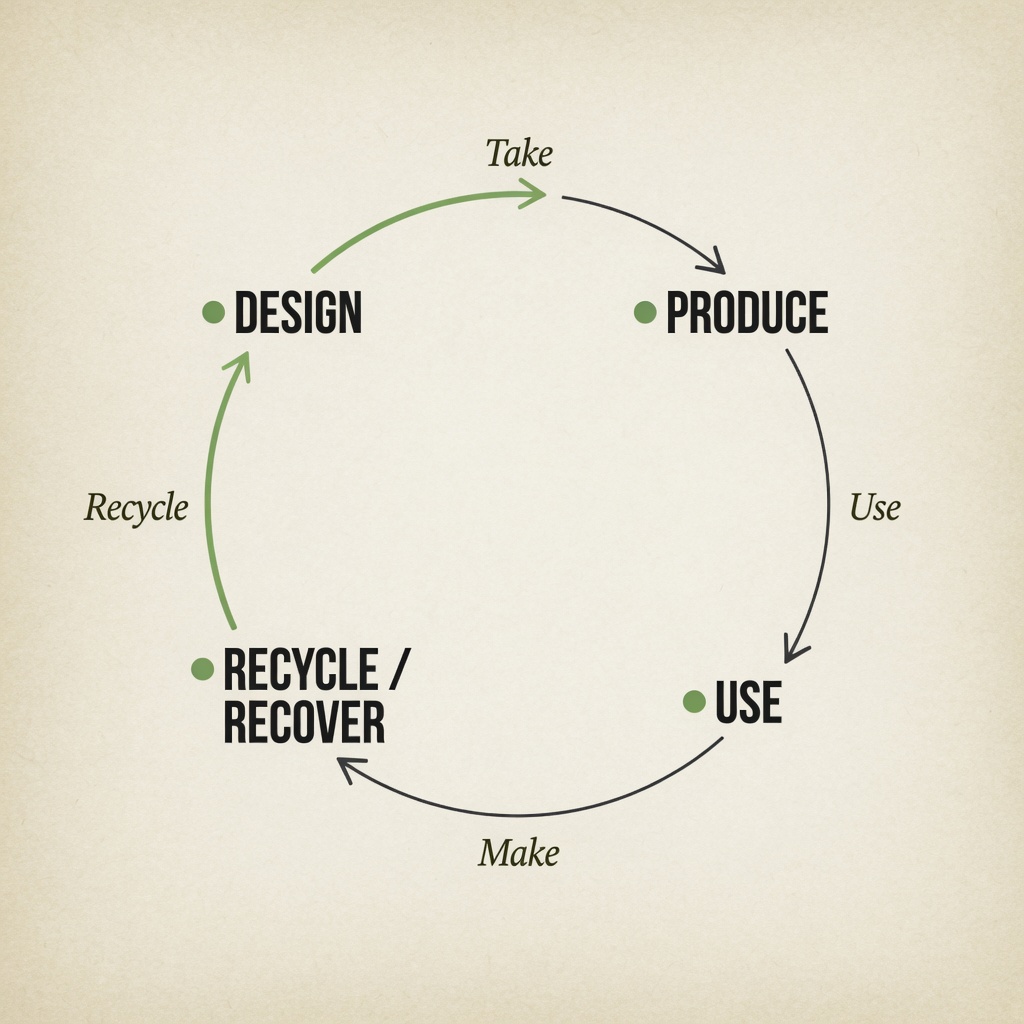
A circular model bends that line into loops:
Design → Make → Use → Recover → Remake
| Dimension | Linear economy | Circular economy |
|---|---|---|
| Design intent | Optimise for low unit cost and convenience | Optimise for longevity, repairability, and material recovery |
| Customer relationship | One-off transaction | Ongoing service, refill, or take-back relationship |
| Material flow | Single use, then disposal | Multiple cycles through reuse, repair, or recycling |
| Revenue model | Sell more units | Revenue from use, service, recovered materials, or certified secondary inputs |
| Risk profile | Exposure to raw material prices and disposal costs | Greater control over material streams; compliance with EPR and packaging tax |
| Measurement | Units sold, margin per unit | Material circulation rate, recovery rate, recycled content %, waste per unit |
The shift is not automatic. It requires cross-functional change—R&D, procurement, finance, legal, operations, and marketing must align. A packaging team cannot deliver circularity if product design specifies unrecyclable multi-material formats, or if finance will not fund take-back logistics.
The Three Loops of Circularity
The Ellen MacArthur Foundation often illustrates circularity through nested loops, from highest to lowest value retention:
1. Inner loop: Maintain and prolong
- Repair and maintenance
- Reuse and redistribution (second-hand markets, B2B asset reuse)
- Refurbishment and remanufacturing
- Product-as-a-service models that retain ownership
These loops preserve embedded energy, labour, and material value. They typically deliver the strongest environmental and economic benefit per unit of effort.
2. Middle loop: Recycle and recover
- Mechanical recycling (e.g. PET bottles to flake to new packaging, where quality allows)
- Chemical recycling (for some plastics where mechanical routes degrade polymer quality)
- Composting for certified compostable materials in appropriate systems—not a default solution for all “bioplastics”
Recycling is essential but is not infinite. Each cycle can downgrade material quality (“downcycling”), and not all streams have viable UK reprocessing capacity.
3. Outer loop: Regenerate
- Returning biological nutrients to soil through industrial composting or anaerobic digestion where appropriate
- Using renewable energy and regenerative sourcing for biological materials
Businesses selling food, agriculture, or fibre products often have the clearest regeneration opportunities—if collection and processing infrastructure exists.
Why the Circular Economy Matters for UK Businesses
Circularity is not only an environmental narrative. For UK organisations, it addresses commercial pressures that show up in boardrooms and balance sheets.
Regulatory and compliance drivers
UK waste and packaging policy is tightening:
- Plastic Packaging Tax — manufacturers and importers of plastic packaging with less than 30% recycled content may owe tax once they exceed the 10-tonne registration threshold. Current rate: £228.82 per tonne from 1 April 2026. Full detail: UK Plastic Packaging Tax.
- Extended producer responsibility (EPR) for packaging — in-scope producers fund the management of packaging waste; data reporting and fee obligations apply to many UK businesses placing packaged goods on the market.
- Simpler Recycling (England) — from 31 March 2025, most workplaces must separate dry recyclables, food waste, and residual waste before collection. Micro-firms (under 10 FTE) have until 31 March 2027. See business waste reduction.
- Waste hierarchy duty — businesses must apply the hierarchy (prevention, preparing for reuse, recycling, other recovery, disposal) and demonstrate efforts to keep waste to a minimum.
These rules make circular design and waste prevention operational priorities, not optional CSR projects.
Financial and supply chain drivers
- Material cost volatility — recycled aluminium, PCR plastic, and recovered fibres can hedge exposure to virgin commodity spikes when supply is secured.
- Customer and retailer requirements — supermarkets, brands, and B2B buyers increasingly specify recycled content, recyclability, and take-back provisions in contracts.
- Investor and lender scrutiny — ESG questionnaires often ask about circular economy strategy, packaging footprint, and waste intensity.
Reputation and green claims risk
The Competition and Markets Authority (CMA) Green Claims Code requires environmental claims to be truthful, clear, and substantiated. Claiming “circular” without evidence of recovery loops, recycled content, or durable design is a greenwashing risk. Be specific: what loop, what percentage, what third-party verification.
Circular Economy Examples: UK and Global Businesses
Real circular economy examples help teams move from theory to benchmarks. The following illustrate different loops—not endorsements of full circularity (few large companies are fully circular today).
Marks & Spencer (M&S)
M&S has long integrated resource efficiency into its Plan A sustainability framework (launched 2007, updated over successive phases). Relevant circular initiatives include:
- Shwopping — customer clothing take-back in partnership with Oxfam, keeping textiles in the reuse loop and raising charity income.
- Packaging reduction and recyclability — targets to remove unnecessary plastic and improve recyclable formats across food and clothing.
- Food waste redistribution — partnerships to divert surplus food from disposal, aligning with the waste hierarchy’s prevention and reuse tiers.
M&S demonstrates how a major UK retailer combines customer-facing take-back with supply chain packaging reform—linking brand trust to measurable material outcomes.
Unilever
Unilever publicly commits to reducing virgin plastic use and increasing recycled content across its portfolio. Initiatives include:
- Refill and reuse pilots — concentrated refills, in-store refill stations, and reusable packaging trials in selected markets.
- Recycled plastic content (PCR) — incorporation of post-consumer recycled material in bottles and containers, supporting Plastic Packaging Tax compliance where applicable.
- Design for recycling — mono-material formats and clear labelling to improve sortability in UK recycling systems.
Unilever’s scale shows how global FMCG businesses use circular economy business models—refill, recycled content, and design standards—to meet retailer, regulator, and investor expectations simultaneously.
Other illustrative UK models
| Company / sector | Circular approach | Loop type |
|---|---|---|
| Brompton Bicycle | Repair, spare parts, long product life | Inner (maintain/prolong) |
| Riversimple | Mobility-as-a-service; retained vehicle ownership | Product-as-a-service |
| Toast Ale | Beer from surplus bread | Middle (recycle/recover inputs) |
| Library of Things | Tool and equipment rental | Product-as-a-service |
| HP / Epson (UK operations) | Printer leasing, cartridge take-back | Service + recovery |
These examples span sectors. Your organisation need not copy a retailer model if you are a B2B manufacturer—remanufacturing components or offering equipment leases may be more material.
Circular Economy Business Model: How Value Is Created
A circular economy business model changes how revenue, assets, and customer relationships work. Common archetypes include:
| Model | How it works | UK relevance |
|---|---|---|
| Product-as-a-service | Customer pays for use; company retains asset and maintains it | Growing in office equipment, textiles, machinery |
| Take-back and reverse logistics | Customer returns product/packaging; company recovers material or resells | Retail clothing, electronics, packaging |
| Remanufacturing | Used products restored to like-new specification | Automotive parts, industrial equipment |
| Sharing platforms | Assets used by multiple users over time | B2B equipment rental, co-working |
| Recycled content products | Virgin material replaced with certified secondary material | Packaging, construction, fashion |
| Industrial symbiosis | One company’s waste becomes another’s input | Manufacturing clusters, food by-products |
Each model has different capex, data, and legal requirements. A detailed comparison with case studies is in circular economy business models.
Frameworks and Standards Supporting Circularity
Businesses often anchor programmes to recognised frameworks:
- Ellen MacArthur Foundation Circular Economy Principles — strategic design lens for boards and innovation teams.
- WRAP — UK-focused guidance on food waste, plastics, and recycling; Business of Recycling supports Simpler Recycling compliance.
- ISO 59004:2024 — Circular economy vocabulary and principles for organisations.
- BS 8001:2017 — British Standard framework for implementing circular economy thinking in organisations (still widely referenced in UK consultancy practice).
- EU Circular Economy Action Plan — relevant for UK firms exporting to the EU or in EU-owned supply chains.
Using a framework helps structure KPIs: recycled content %, recovery rate, waste per unit, product life extension, and circular revenue share.
Implementation Path for UK Organisations
Circularity is implemented in stages. The following path suits SMEs and larger enterprises alike—scale depth to your material impacts.
Step 1: Map material flows
Document what enters your business (raw materials, packaging, consumables) and what leaves (product, waste streams, WEEE, food waste). Use existing waste transfer notes and procurement data. This baseline supports business waste reduction targets and packaging tax assessments.
Step 2: Prioritise by impact and feasibility
Apply a materiality lens:
- High spend / high volume materials first (e.g. primary packaging, core product inputs).
- Regulatory exposure (plastic packaging, EPR-liable formats).
- Customer asks in tenders and retailer scorecards.
Do not attempt every circular loop at once.
Step 3: Design and procurement interventions
- Specify recyclable mono-materials where recycling infrastructure exists.
- Set minimum recycled content thresholds aligned with tax and customer requirements.
- Design for disassembly, repair, and standard parts.
- Include circular criteria in sustainable procurement policies.
Step 4: Build recovery systems
- Pilot take-back with loyal B2B customers or retail partners.
- Contract licensed waste carriers and verify end destinations.
- Track mass balance of recovered material—needed for Plastic Packaging Tax credits and credible claims.
Step 5: Measure, report, and improve
Integrate circular KPIs into management reporting and, where relevant, ESG reporting or sustainability KPIs. Review annually as regulation and technology evolve.
Circular Economy and Carbon: How They Connect
Circularity and climate action overlap but are not identical. Keeping materials in use often reduces Scope 3 emissions associated with virgin extraction and processing. However:
- Recycling is not carbon-free — collection, sorting, and reprocessing consume energy.
- Product life extension may delay replacement of more efficient new models—analyse trade-offs.
- Carbon claims require the same rigour as circular claims. See Scope 1, 2, and 3 emissions and net zero strategy for integration.
The strongest business case often combines waste cost reduction, packaging tax avoidance, and moderate carbon benefits—with clear data for each.
Common Mistakes and Greenwashing Risks
| Mistake | Why it fails | Better approach |
|---|---|---|
| Labelling all recycling as “circular” | Circularity requires design upstream, not only end-of-pipe sorting | Distinguish recycling rate from circular design scorecard |
| Ignoring UK recycling reality | Not all “recyclable” formats are collected or reprocessed at scale | Design for actual UK collection systems; consult WRAP guidance |
| Compostable packaging without infrastructure | Many workplaces cannot compost packaging with food waste | Match format to available processing; see Simpler Recycling rules |
| No data on recycled content | Plastic Packaging Tax and EPR require evidence | Implement supplier certificates and mass balance records |
| Vague “closed loop” marketing | CMA and ASA enforce substantiation | State specific % recycled content, recovery partner, and scope |
For marketing teams, cross-check claims against the UK Green Claims Code.
Comparison Table: Linear vs Circular Indicators
Use this table in workshops to assess where your organisation sits today.
| Indicator | Typically linear | Moving toward circular |
|---|---|---|
| Product design | Single-use, sealed, irreparable | Modular, repairable, upgradeable |
| Packaging | Virgin plastic, multi-layer | Recycled content, recyclable mono-material |
| Customer offer | Ownership transfer only | Refill, lease, or take-back option |
| Waste contract | General waste skip | Segregated streams per Simpler Recycling |
| Supplier specs | Lowest unit cost | Recycled content + recyclability mandatory |
| Governance | Sustainability as marketing | Material KPIs in management accounts |
How This Pillar Connects to the Wider Site
Circular Economy & Waste sits alongside carbon, procurement, and reporting content:
- Fundamentals: What is sustainability in business?
- Carbon: Business carbon footprint | Reduce carbon footprint
- Procurement: Sustainable procurement guide
- Reporting: ESG reporting | Sustainability KPIs
- Trust: What is greenwashing? | Editorial standards
Frequently Asked Questions
What is the circular economy?
The circular economy is an economic model that eliminates waste by design, keeps products and materials in use through reuse, repair, and recycling, and regenerates natural systems where possible. It replaces the linear take-make-dispose approach with closed material loops.
What is a circular economy in simple terms for business?
For business, it means making money without constantly throwing away valuable materials—by designing longer-lasting products, recovering packaging, using recycled inputs, and sometimes selling services instead of one-off products.
What is the circular economy definition used in the UK?
UK policy aligns with the Ellen MacArthur Foundation principles and the statutory waste hierarchy: prevent waste first, then reuse, recycle, recover energy, and dispose only as a last resort. Packaging tax and EPR add financial incentives for recycled content and producer-funded collection.
What are circular economy examples in the UK?
Examples include M&S clothing take-back (Shwopping), Unilever’s refill and recycled plastic programmes, remanufacturing in automotive and industrial sectors, and product-as-a-service models for equipment and mobility.
What is the difference between linear vs circular economy?
The linear economy extracts resources, makes products, and disposes of them. The circular economy loops materials back through reuse, repair, remanufacturing, and recycling—reducing virgin resource use and waste disposal.
Is recycling the same as the circular economy?
No. Recycling is one part of circularity. A full circular economy also emphasises waste prevention, product longevity, reuse, and business models that keep assets in productive use—not only end-of-life material recovery.
How does the circular economy relate to the UK Plastic Packaging Tax?
The tax applies to plastic packaging with less than 30% recycled plastic content (above registration thresholds). Using recycled content and designing recyclable packaging supports both circular goals and tax efficiency. See UK Plastic Packaging Tax.
Do small UK businesses need a circular economy strategy?
SMEs benefit from practical waste reduction and packaging choices even without a formal strategy. Simpler Recycling rules apply to most English workplaces; packaging tax and EPR may affect smaller firms through supply chain pass-through costs. Start with business waste reduction.
How do I avoid greenwashing with circular economy claims?
Be specific about what is circular (e.g. 50% recycled content, verified take-back rate), define scope, and hold evidence. Follow CMA Green Claims Code principles and avoid implying full circularity from a single initiative.
Sources and Further Reading
- Ellen MacArthur Foundation — What is the circular economy?
- UK Government / HMRC — Plastic Packaging Tax: steps to take (rates updated 12 February 2026)
- UK Government / Defra — Simpler recycling: workplace recycling in England
- UK Government — Guidance on applying the waste hierarchy
- WRAP — Business of Recycling
- Competition and Markets Authority — Green Claims Code
- ISO 59004:2024 — Circular economy vocabulary and principles
Regulatory rates and waste rules change. Verify current UK obligations with official HMRC, Defra, and Environment Agency sources before relying on compliance statements.
Next Steps
Choose your next read based on your immediate decision:
- Choosing a commercial model → Circular economy business models
- Reducing operational waste → Business waste reduction
- Packaging tax compliance → UK Plastic Packaging Tax
- Integrating with carbon strategy → How to reduce business carbon footprint
- Protecting claim credibility → How to avoid greenwashing