
Biodiversity Net Gain: A Guide for UK Developers and Businesses
Biodiversity Net Gain: A Guide for UK Developers and Businesses
Last updated: 24 June 2026 | Author: VerdaScope Editorial Team
Biodiversity net gain (BNG) is now a mandatory planning requirement for most new development in England. Under the statutory framework introduced by the Environment Act 2021, developers must deliver at least a 10% net gain in biodiversity value relative to pre-development onsite habitat — measured using the statutory biodiversity metric and secured through a Biodiversity Gain Plan approved before work starts. If you are a developer, land manager, architect, contractor, or planning consultant, understanding BNG requirements UK rules is no longer optional for in-scope projects.
This guide explains what mandatory biodiversity net gain means in practice, who it applies to, key dates, how BNG planning works from application to enforcement, and how BNG connects to wider nature recovery UK policy. For construction-specific sustainability standards, see our sustainable construction UK guide. For the legislative context, see UK sustainability legislation.
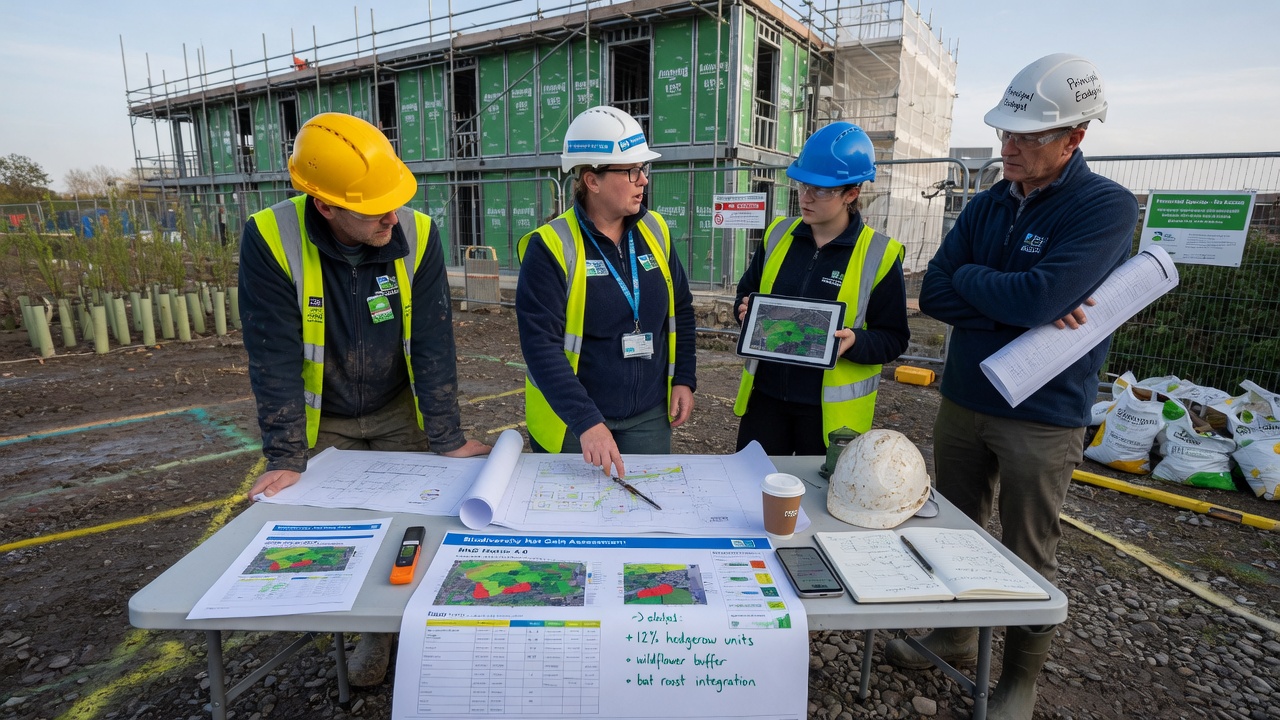
Status Summary (June 2026)
| Item | Position |
|---|---|
| Geography | England only (separate rules may apply in Scotland, Wales, and Northern Ireland) |
| Legal basis | Schedule 7A, Town and Country Planning Act 1990 (inserted by Environment Act 2021) |
| Mandatory from | 12 February 2024 for most planning permissions granted on applications made on or after that date |
| Net gain target | At least 10% increase in biodiversity value vs pre-development onsite habitat |
| Pre-commencement | Biodiversity Gain Plan must be approved before development commences |
| NSIPs | BNG for nationally significant infrastructure projects expected from 2 November 2026 (separate rules) |
Source: GOV.UK — Biodiversity net gain; GOV.UK — Understanding biodiversity net gain (updated 2 June 2026).
Direct Answer
What is biodiversity net gain?
Biodiversity net gain is a statutory planning requirement in England that ensures development leaves habitats in a measurably better state than before. Developers must deliver at least a 10% increase in biodiversity value (using the statutory biodiversity metric) through onsite habitat creation or enhancement, registered offsite gains, or — as a last resort — statutory biodiversity credits. Unless exempt, a Biodiversity Gain Plan must be approved by the local planning authority before development can start.
Key Takeaways
- Mandatory biodiversity net gain applies in England under Schedule 7A of the Town and Country Planning Act 1990, inserted by the Environment Act 2021.
- The biodiversity gain objective is at least 10% net gain measured against pre-development onsite habitat value using the statutory biodiversity metric.
- BNG applies to planning permissions granted on applications made on or after 12 February 2024, subject to exemptions and transitional arrangements.
- Development cannot commence until the local planning authority approves the Biodiversity Gain Plan — a pre-commencement condition.
- Delivery follows the biodiversity gain hierarchy: avoid and mitigate harm, then prioritise onsite enhancement, then registered offsite gains, then statutory credits.
- Significant onsite and offsite gains must be maintained for at least 30 years under legal agreements.
- Habitat banking (registering land for offsite biodiversity units) creates a market for land managers; developers can buy registered offsite units when onsite delivery is insufficient.
- BNG sits alongside — but is distinct from — the NPPF mitigation hierarchy and other biodiversity policies.
What Is Biodiversity Net Gain?
Biodiversity net gain requires development to have a positive, measurable impact on biodiversity. It is not a voluntary corporate commitment or a generic “nature positive” pledge. In England, it is a statutory planning framework that deems most grants of planning permission subject to a biodiversity gain condition.
The condition requires development to meet the biodiversity gain objective: delivering at least a 10% increase in biodiversity value relative to the pre-development biodiversity value of onsite habitat. This is calculated using biodiversity units generated by the statutory biodiversity metric, which considers habitat type, size, distinctiveness, condition, and location.
BNG can be delivered through:
- Onsite gains — creating or enhancing habitat within the development red line boundary
- Registered offsite gains — biodiversity units from land registered on the national Biodiversity Gain Site register
- Statutory biodiversity credits — purchased from government as a last resort when onsite and offsite delivery are insufficient
The statutory framework is designed as a post-permission mechanism: planning permission can be granted, but the developer must submit and obtain approval of a Biodiversity Gain Plan before commencing development. However, BNG must be considered throughout the planning process — from site selection and pre-application discussions through to application submission and decision-making.
Who Does BNG Apply To?
In scope
BNG applies to planning permissions granted in England for applications made on or after 12 February 2024, unless an exemption or transitional provision applies. Relevant parties include:
| Role | Why BNG matters |
|---|---|
| Developers | Must meet the 10% objective and secure an approved Biodiversity Gain Plan |
| Landowners / land managers | Can register sites and sell offsite biodiversity units (habitat banking) |
| Ecologists and consultants | Survey habitat, complete metric calculations, prepare gain plans |
| Architects and designers | Integrate habitat into masterplans early to reduce cost and risk |
| Contractors | Must not commence until the gain plan is approved; deliver secured enhancements |
| Local planning authorities | Validate applications, determine permissions, approve gain plans, enforce delivery |
Exempt developments
Certain development types are exempt from the biodiversity gain condition. Key exemptions include:
| Exemption | Detail |
|---|---|
| Householder development | Applications within the householder definition (extensions, loft conversions, etc.) |
| Permitted development | Development granted by development order under section 59 |
| De minimis | No impact on priority habitat AND less than 25 m² of other onsite habitat AND less than 5 m of linear habitat (e.g. hedgerows) |
| Self-build and custom build | No more than 9 dwellings, site ≤ 0.5 hectares, exclusively self/custom build |
| Biodiversity gain site development | Development solely or mainly to deliver BNG for another project |
| Retrospective permissions | Section 73A retrospective permissions |
| Transitional section 73 | Section 73 applications where the original permission predates 12 February 2024 |
A temporary exemption applied to non-major development until 2 April 2024. Applications made before 12 February 2024 are not subject to BNG, even if permission is granted later.
Not yet in scope (at June 2026)
BNG has not yet been commenced for permissions granted through:
- Local development orders
- Simplified Planning Zones
- Neighbourhood development orders
- Successful enforcement appeals
- Deemed planning permission
Permission in principle is not in scope, but subsequent technical details consent would be. Reserved matters approvals are not grants of planning permission and are not subject to the condition.
Nationally significant infrastructure projects (NSIPs) will be subject to BNG from 2 November 2026, under separate rules.
What Businesses Need to Do: A Practical Workflow
Phase 1: Early feasibility (pre-application)
- Confirm whether BNG applies — check exemptions, transitional rules, and application date
- Commission habitat surveys — ideally shortly before application submission
- Run the statutory biodiversity metric — establish pre-development baseline biodiversity value
- Apply the biodiversity gain hierarchy — avoid adverse effects on medium/high/very high distinctiveness habitats; mitigate where avoidance is impossible
- Explore onsite delivery options — layout, landscaping, green infrastructure, retention of valuable habitat
- Assess offsite market — search the Biodiversity Gain Sites register for available units
- Engage the LPA — use pre-application services to test strategy and information requirements
- Budget for 30-year maintenance — legal agreements, monitoring, and management plans
Phase 2: Planning application
If BNG applies, minimum information requirements include:
- Confirmation the development is subject to the biodiversity gain condition
- Pre-development biodiversity value (date of application or agreed earlier date)
- Completed statutory biodiversity metric calculation tool
- Habitat plans showing existing onsite habitat (including irreplaceable habitat)
- Statement on any pre-application habitat degradation
- Description of proposed significant onsite enhancements (where relevant)
If claiming an exemption, the application must state which exemption applies and provide supporting evidence — especially for the de minimis exemption.
LPAs may request additional information proportionate to development scale and habitat sensitivity.
Phase 3: Post-permission — Biodiversity Gain Plan
After permission is granted:
- Prepare the Biodiversity Gain Plan — demonstrate how the 10% objective will be met
- Submit metric calculations showing post-development onsite value, allocated offsite units, and any credits purchased
- Secure legal agreements — planning obligations, conditions, or conservation covenants for 30-year maintenance
- Obtain LPA approval — the authority must approve or refuse within 8 weeks
- Do not commence until the plan is approved — commencing without approval is a breach of planning control
Phase 4: Delivery and monitoring
- Implement habitat creation and enhancement per approved plans
- Maintain habitats for at least 30 years (from completion of development and habitat works)
- Prepare Habitat Management and Monitoring Plans (HMMP) where required
- Cooperate with LPA enforcement if commitments are not met
Key Dates and Deadlines
| Date | Event |
|---|---|
| November 2021 | Environment Act 2021 receives Royal Assent |
| 12 February 2024 | Mandatory BNG commences for most planning applications in England |
| 2 April 2024 | Temporary exemption for non-major development ends |
| 2 November 2026 | BNG expected to apply to nationally significant infrastructure projects |
| Ongoing | Biodiversity Gain Plan approval required before each in-scope development commences |
Reporting and evidence cycles
Unlike annual corporate reporting regimes such as SECR, BNG is a project-level planning obligation. Evidence requirements centre on:
- Planning application baseline data
- Approved Biodiversity Gain Plan and metric tool outputs
- Registration of offsite gains on the national register
- Purchase records for statutory biodiversity credits
- HMMPs and monitoring reports over the 30-year maintenance period
The Statutory Biodiversity Metric
The biodiversity metric converts habitat data into standardised biodiversity units — a proxy for biodiversity value. The statutory biodiversity metric must be used for BNG compliance.
Inputs include:
- Habitat type and size
- Distinctiveness (from very low to very high)
- Condition (e.g. poor, moderate, good)
- Strategic significance / location in the local area
For smaller developments, a small sites biodiversity metric tool may be used without requiring a qualified ecologist — though professional advice is still advisable for complex sites.
Official tools and guidance: GOV.UK — Biodiversity metric.
The Biodiversity Gain Hierarchy
Developers must follow the biodiversity gain hierarchy when discharging the gain condition:
- Avoid adverse effects on onsite habitats with medium, high, or very high distinctiveness
- Mitigate adverse effects where avoidance is not possible
- Compensate by prioritising, in order:
- Enhancement of existing onsite habitats
- Creation of new onsite habitats
- Allocation of registered offsite gains
- Purchase of statutory biodiversity credits (last resort)
The hierarchy is distinct from the mitigation hierarchy in paragraph 186 of the National Planning Policy Framework, which addresses significant harm to biodiversity at the decision stage. Both may be relevant to the same application.
Onsite, Offsite, and Credits: How Delivery Works
Onsite gains
Onsite habitat creation and enhancement within the red line boundary is the preferred route. Significant onsite enhancements must be secured by planning condition, section 106 agreement, or conservation covenant for at least 30 years after development completion.
Offsite gains and habitat banking
When onsite delivery is insufficient, developers can:
- Create offsite gains on land they own outside the red line boundary, or
- Buy registered offsite biodiversity units from land managers
Land managers can register land as a biodiversity gain site on the national register, enter a 30-year legal agreement, and sell units to developers. This habitat banking market supports nature recovery UK objectives and Local Nature Recovery Strategies.
Offsite allocations must be recorded on the Biodiversity Gain Sites register with landowner permission.
Statutory biodiversity credits
If onsite and offsite options cannot deliver the full 10% objective, developers must buy statutory biodiversity credits from government. Credits are intentionally priced as a last resort to incentivise onsite and market-based offsite delivery. Revenue funds habitat creation in England.
How BNG Relates to Adjacent Standards and Policy
BNG does not replace other sustainability requirements. It intersects with:
| Framework | Relationship to BNG |
|---|---|
| Sustainable construction UK | BREEAM, Passivhaus, and Future Homes Standard address energy and materials; BNG addresses habitat |
| NPPF paragraph 185–186 | Plan-making and decision-making biodiversity policies; mitigation hierarchy for significant harm |
| Local Nature Recovery Strategies | Inform offsite gain site selection and local habitat priorities |
| Irreplaceable habitats | Separate compensation arrangements; cannot be offset through standard metric trading alone |
| UK sustainability legislation | Environment Act 2021 is the parent statute for mandatory BNG |
| Environmental Impact Assessment | May overlap on large projects; BNG is a separate statutory condition |
| Net zero guide | Operational carbon reduction is complementary; BNG addresses ecological impact |
For developers pursuing broader green credentials, BNG should be integrated into project governance alongside embodied carbon management and sustainable procurement for landscaping and materials.
Examples: Compliant, Incomplete, and Risky Approaches
Compliant approach
A residential developer applies for 80 homes on a former arable field with hedgerows and a pond. Early surveys establish the baseline metric score. The masterplan retains the pond and hedgerows, adds species-rich grassland and street trees, and achieves 6% gain onsite. The remaining 4% is secured through registered offsite units from a local habitat bank. A section 106 agreement secures 30-year maintenance. The Biodiversity Gain Plan is submitted and approved before groundworks begin.
Incomplete approach
A developer submits a planning application with baseline habitat data but no strategy for post-development gains, assuming the LPA will resolve this at the gain plan stage. The application may be valid, but the LPA may question whether the gain condition can be discharged. Delay, redesign, and cost escalation are likely. Early metric modelling of post-development value reduces this risk.
Risky approach
A developer clears vegetation before survey to reduce the baseline score (“habitat degradation”). Regulations discourage this: if degradation occurred before application, the pre-degradation biodiversity value may be used. The developer also plans to buy credits without exploring onsite options, increasing cost and attracting scrutiny for failing the biodiversity gain hierarchy. Marketing the scheme as “nature positive” without referencing the statutory 10% obligation and evidence may also create greenwashing risk in sales materials.
Common Mistakes and Source Caveats
| Mistake | Why it matters |
|---|---|
| Treating BNG as a landscaping afterthought | Habitat design affects viability, layout, and unit costs |
| Ignoring irreplaceable habitat | Ancient woodland and other irreplaceable habitats have special rules |
| Assuming householder rules apply to larger schemes | Exemptions are narrow; most commercial and residential schemes are in scope |
| Commencing before gain plan approval | Breach of planning control; enforcement action possible |
| Using non-statutory metrics | Only the statutory biodiversity metric satisfies the legal requirement |
| Underestimating 30-year costs | Maintenance, monitoring, and legal compliance extend well beyond build-out |
| Conflating BNG with carbon offsetting | Biodiversity units and carbon credits are separate instruments |
Update log
| Date | Change |
|---|---|
| 12 February 2024 | Mandatory BNG commences for most England planning applications |
| 2 April 2024 | Non-major development temporary exemption ends |
| 2 June 2026 | GOV.UK updates NSIP commencement date to 2 November 2026 |
| 24 June 2026 | This guide published |
Planning law and BNG guidance evolve. Verify current requirements with GOV.UK BNG guidance, your local planning authority, and qualified ecologists before relying on compliance statements.
BNG Planning Process: Summary Table
| Stage | Developer action | LPA role |
|---|---|---|
| Pre-application | Surveys, metric baseline, strategy | Advice on requirements and local policy |
| Application | Submit minimum BNG information or exemption statement | Validate; consult; determine application |
| Permission granted | Prepare Biodiversity Gain Plan | — |
| Gain plan submission | Metric, legal agreements, HMMP | Approve or refuse within 8 weeks |
| Commencement | Start only after approval | Monitor compliance |
| Post-completion | Maintain habitat 30 years | Enforcement if commitments breached |
FAQ
What is biodiversity net gain?
Biodiversity net gain is a mandatory requirement in England for most new development to deliver at least a 10% increase in biodiversity value compared with pre-development onsite habitat, measured using the statutory biodiversity metric and secured through an approved Biodiversity Gain Plan.
When did mandatory biodiversity net gain start in the UK?
Mandatory BNG commenced in England on 12 February 2024 for planning permissions granted on applications made on or after that date. It does not currently apply in the same form in Scotland, Wales, or Northern Ireland.
Is biodiversity net gain required for all development?
No. Exemptions include householder development, permitted development, de minimis impacts, qualifying self-build schemes, and applications made before 12 February 2024. Check exempt developments guidance for full detail.
What is the 10% biodiversity net gain requirement?
Developers must deliver biodiversity value at least 10% higher than the pre-development onsite habitat baseline. The percentage is calculated in biodiversity units using the statutory metric, combining onsite gains, registered offsite gains, and statutory credits.
What is a Biodiversity Gain Plan?
A Biodiversity Gain Plan is a document submitted to the local planning authority after permission is granted, demonstrating how the development will meet the biodiversity gain objective. It must be approved before development commences.
What is the biodiversity gain hierarchy?
The hierarchy prioritises avoiding harm to valuable habitats, mitigating unavoidable impacts, then delivering gains through onsite enhancement, onsite creation, registered offsite units, and finally statutory credits.
What is habitat banking?
Habitat banking refers to registering land as a biodiversity gain site, creating or enhancing habitat, and selling biodiversity units to developers who need offsite gains to meet mandatory BNG requirements.
Do I need an ecologist for BNG?
For most major development, yes — qualified ecologists should survey habitat and complete metric calculations. Small developments may use the small sites metric tool without an ecologist, though professional input is advisable for anything beyond straightforward sites.
How long must BNG habitats be maintained?
Significant onsite gains and offsite gains must be maintained for at least 30 years, secured through planning conditions, section 106 agreements, or conservation covenants.
Can biodiversity net gain be varied or removed?
No. The biodiversity gain condition cannot be varied or removed through a section 73 application.
How does BNG relate to the Environment Act 2021?
Schedule 14 of the Environment Act 2021 inserted Schedule 7A (Biodiversity Gain in England) into the Town and Country Planning Act 1990, creating the statutory framework for mandatory BNG.
What are statutory biodiversity credits?
Government-issued credits that developers purchase when onsite and offsite delivery cannot achieve the full BNG obligation. They are a last resort under the biodiversity gain hierarchy.
Sources and Further Reading
- GOV.UK — Biodiversity net gain (planning guidance, updated May 2024)
- GOV.UK — Understanding biodiversity net gain (updated 2 June 2026)
- GOV.UK — Meet biodiversity net gain requirements: steps for developers
- GOV.UK — Biodiversity metric
- Legislation — Environment Act 2021
- Legislation — Schedule 7A, Town and Country Planning Act 1990
- Future Homes Hub — Biodiversity net gain resources
Next Steps
Choose your next read based on your role:
- Construction and design standards → Sustainable construction UK
- Legislative overview → UK sustainability legislation
- Carbon alongside ecology → Net zero guide
- Smaller developers and contractors → Sustainability for small businesses
- Credible environmental claims → How to avoid greenwashing
Mandatory biodiversity net gain is now a core planning compliance issue for England’s development sector. Treat BNG as a design and viability input from day one — not a box to tick after permission is granted.