
How to Build a Business Sustainability Strategy: The Complete Guide
How to Build a Business Sustainability Strategy: The Complete Guide
Last updated: 24 June 2026 | Author: VerdaScope Editorial Team
Effective business sustainability strategies translate environmental and social responsibility into governed priorities, measurable sustainability goals business leaders can fund, and operational change people can deliver. For UK organisations facing SECR reporting, customer ESG questionnaires, supply chain audits, or board-level climate risk discussions, building sustainability strategy is how you move from ad hoc initiatives to a credible corporate sustainability strategy with a clear sustainability roadmap and accountable embedding sustainability across the business.
This pillar guide is the strategic hub for Strategy & Operations. It covers the full framework—materiality, governance, goals, delivery, and reporting—with links to deeper guides and a downloadable sustainability strategy template.
Direct Answer
A business sustainability strategy is a board-approved plan that identifies material environmental and social impacts, sets measurable targets, assigns governance and resources, sequences initiatives through a sustainability roadmap, and connects delivery to credible reporting. UK businesses should start with stakeholder-informed materiality assessment, align with regulatory obligations (SECR, TCFD, UK SRS where applicable), and embed sustainability into operations—not treat it as a communications add-on.
Key Takeaways
- Business sustainability strategies must be grounded in materiality—not every ESG topic deserves equal priority.
- Secure board mandate and named executive ownership before launching initiatives; strategy without governance fails.
- Set a small number of measurable sustainability goals business teams can own, linked to sustainability KPIs.
- Sequence delivery through a phased sustainability roadmap with quick wins, medium-term investments, and structural change.
- Connect strategy to operations via sustainable operations, environmental management systems, and people programmes.
- Report progress honestly; public claims must comply with the UK Green Claims Code.
- Review strategy annually and after major business changes—materiality is not a one-off exercise.
Strategy & Operations: Topic Map
This pillar covers how UK businesses plan, run, and embed sustainability. Use the map below to navigate supporting guides.
| Cluster | Guide | What it covers |
|---|---|---|
| Strategy | Materiality assessment | Identifying what matters to business and stakeholders |
| Operations | Sustainable operations | Energy, water, waste, logistics in day-to-day running |
| Operations | Environmental management system | Structured EMS framework for UK businesses |
| Operations | ISO 14001 certification | Certification process, costs, and requirements |
| Travel & Logistics | Sustainable business travel | Travel policy, carbon reduction, rail vs flying |
| People & Culture | Employee sustainability engagement | Workforce programmes and green culture |
| People & Culture | Sustainable HR practices | Social sustainability in people teams |
Related reporting and foundations:
- ESG strategy — broader E, S, and G governance framework
- Net zero strategy — climate pathway when emissions are material
- Sustainability reporting guide — disclosure frameworks
What Is a Sustainable Business Strategy?
A corporate sustainability strategy integrates environmental and social considerations into how a business creates value—across operations, supply chain, products, workforce, and governance. It is not a standalone CSR document; it is a management discipline linking material impacts to decisions, budgets, and accountability.
Strategy vs policy vs roadmap
| Element | Purpose | Typical owner |
|---|---|---|
| Sustainability policy | States principles and commitments | Board / executive team |
| Sustainability strategy | Defines priorities, targets, and delivery approach | Executive sponsor + working group |
| Sustainability roadmap | Phased plan with timelines, owners, and budget | Operations / sustainability lead |
| Initiatives | Specific projects (energy retrofit, supplier programme, travel policy) | Functional owners |
A credible strategy document should answer four questions stakeholders ask:
- What matters most to our business and stakeholders? (materiality)
- What will we achieve and by when? (goals and KPIs)
- How will we deliver and who is accountable? (roadmap and governance)
- How will we prove progress? (data, audit, reporting)
Why UK Businesses Need a Formal Sustainability Strategy
Drivers vary by sector and size, but UK organisations commonly face:
| Driver | Example | Strategic response |
|---|---|---|
| Regulation | SECR, TCFD (premium listed), UK SRS (developing), CSRD for EU-exposed groups | Map obligations into strategy scope |
| Customers | Retailer supplier scorecards, public sector tenders | Prioritise customer material topics |
| Finance | Lender covenants, investor ESG questionnaires | Align KPIs with disclosure expectations |
| Risk | Climate physical risk, resource costs, reputational exposure | Integrate into enterprise risk management |
| Talent | Employee expectations on purpose and climate action | Link to employee sustainability engagement |
| Efficiency | Energy and waste cost reduction | Operational quick wins fund longer programmes |
UK SMEs often start because a key customer demands evidence of environmental management—not because of domestic mandatory sustainability reporting. A documented strategy helps you respond consistently without overclaiming.
The Five-Part Sustainability Strategy Framework
Use this framework when building sustainability strategy. Each part produces a documented output.
1. Materiality and baseline
Identify which environmental and social topics are material—significant to business success and/or stakeholders—and establish baseline data.
Actions:
- Map sustainability topics across operations and value chain
- Conduct materiality assessment with internal and external stakeholder input
- Review mandatory obligations: SECR, TCFD, CSRD requirements if EU-exposed, Modern Slavery Act
- Collect baseline data for top five material topics
- Document gaps in data, policy, and capability
Output: Materiality matrix, priority topic list, baseline year data summary.
2. Governance and leadership
Assign board oversight, executive sponsorship, and cross-functional delivery structures.
Actions:
- Brief board on drivers, risks, and opportunities
- Assign board committee or designated director oversight
- Appoint executive sponsor (often CFO, COO, or dedicated sustainability lead)
- Form working group spanning finance, operations, procurement, HR, legal, and communications
- Document terms of reference and decision rights
Output: Governance charter, meeting cadence, escalation routes.
UK context: Premium listed companies should align governance descriptions with TCFD reporting expectations. Organisations preparing for UK Sustainability Reporting Standards should design governance that can support future S1/S2 disclosures.
3. Goals, targets, and KPIs
Translate material topics into measurable sustainability goals business leaders approve and fund.
Principles for credible targets:
- Base on baseline data, not aspiration alone
- Include interim milestones (annual or biennial)
- Assign one accountable owner per target
- Avoid public commitments you cannot evidence—see how to avoid greenwashing
Example goal set (illustrative UK mid-market manufacturer):
| Material topic | Goal | KPI | Target year |
|---|---|---|---|
| Energy and emissions | Reduce scope 1+2 intensity | tCO₂e per £m revenue | 2030 |
| Waste | Divert 90% non-hazardous waste from landfill | % diversion rate | 2028 |
| Supply chain | Assess top 50 suppliers on labour and environment | % suppliers assessed | 2027 |
| Workforce | Maintain accredited health and safety management | Lost-time injury frequency | Ongoing |
Link KPIs to sustainability KPIs guidance for definitions and data sources.
4. Roadmap and initiatives
Build a sustainability roadmap sequencing initiatives by impact, cost, and dependency.
Typical phasing:
| Phase | Timeline | Focus | Examples |
|---|---|---|---|
| Phase 1: Foundation | 0–12 months | Governance, baselines, quick wins | LED lighting, travel policy, waste audit, EMS scoping |
| Phase 2: Scale | 12–36 months | Structural improvements | Renewable energy, supplier programme, fleet transition |
| Phase 3: Transform | 36+ months | Business model and value chain | Product redesign, circular models, science-based targets |
Each initiative on the roadmap should include: owner, budget estimate, dependencies, KPI link, and reporting milestone.
5. Reporting, assurance, and review
Connect strategy to credible disclosure and continuous improvement.
Actions:
- Define reporting boundary and frequency (annual minimum for external stakeholders)
- Align with applicable frameworks: SECR, GRI, ISSB, customer templates
- Plan sustainability audit or assurance where stakeholders require it
- Review materiality and targets annually
- Update public claims only when evidenced
Output: Reporting calendar, data ownership matrix, annual review process.
How to Integrate Sustainability into Business Strategy
Embedding sustainability means sustainability priorities appear in board papers, capital allocation, procurement rules, HR policies, and product development—not only in a standalone PDF.
Integration points
| Business function | Integration lever | Example |
|---|---|---|
| Finance | Capex appraisal, carbon cost internalisation | Require carbon assessment for projects above threshold |
| Procurement | Contract clauses, supplier scorecards | Environmental and labour criteria in sustainable procurement |
| Operations | Sustainable operations, EMS | ISO 14001-aligned environmental management system |
| HR | Policies, benefits, engagement | Sustainable HR practices, green teams |
| Marketing | Claims governance | Legal review against UK Green Claims Code |
| Strategy / M&A | Due diligence | Climate and ESG risk in investment decisions |
Board integration checklist
- Sustainability risks on enterprise risk register
- Material topics in annual board strategy review
- Executive remuneration linked to material KPIs (where appropriate and defensible)
- Capital allocation criteria include environmental efficiency
- M&A due diligence includes ESG screening
UK Implementation Path
Follow this path tailored to UK organisational context.
Step 1: Scope and sponsor (Weeks 1–4)
Secure executive sponsor and define organisational boundary (entities, sites, value chain depth for materiality).
Step 2: Materiality and obligations (Weeks 4–12)
Run materiality workshops; map SECR, TCFD, UK SRS, CSRD, and customer requirements.
Step 3: Baseline and gap analysis (Weeks 8–16)
Collect energy, waste, travel, and workforce data; identify capability gaps.
Step 4: Draft strategy and roadmap (Weeks 12–20)
Produce strategy document, KPI set, and phased roadmap with budget estimates.
Step 5: Board approval (Week 20–24)
Present for approval: materiality summary, goals, governance, roadmap, and reporting plan.
Step 6: Launch and embed (Month 6+)
Communicate internally, assign initiative owners, start Phase 1 delivery, establish quarterly steering.
Step 7: Report and refresh (Ongoing)
Publish annual progress; refresh materiality after significant business change.
Sustainability Strategy Template
Use this structure for your sustainability strategy template. Adapt sections to your size and sector.
Document structure
- Executive summary — purpose, material topics, three-year headline goals
- Context — business model, sector risks, regulatory landscape (UK)
- Materiality — methodology, stakeholder input, priority matrix
- Vision and principles — sustainability policy statements
- Goals and KPIs — targets with baselines and owners
- Governance — board oversight, working group, escalation
- Roadmap — phased initiatives with timelines and budget
- Reporting — frameworks, frequency, assurance approach
- Risks — delivery risks, greenwashing controls
- Appendices — data tables, stakeholder list, regulatory mapping
One-page strategy on a page
| Section | Content |
|---|---|
| Why | Top three drivers (regulation, customers, risk) |
| What matters | Top 5 material topics |
| Where we’re going | 3 headline goals with target years |
| How | 5 Phase 1 initiatives with owners |
| Proof | KPIs and reporting commitment |
Downloadable template: link from sustainability resources when published.
How to Make Your Business More Sustainable: Quick-Action Checklist
For organisations needing immediate progress while building full strategy:
- Appoint an executive sponsor and form a small working group
- Measure scope 1 and 2 emissions if not already done (scope 1, 2 and 3 emissions)
- Switch to renewable electricity where contracts allow (renewable energy for business)
- Implement a sustainable business travel policy
- Audit waste streams and set diversion targets (business waste reduction)
- Screen top suppliers on environmental and labour criteria
- Launch employee engagement programme (employee sustainability engagement)
- Review public marketing claims for accuracy (making legitimate green marketing claims)
Common Mistakes and Greenwashing Risks
| Mistake | Why it fails | Fix |
|---|---|---|
| Strategy without materiality | Misallocated resources | Run structured materiality assessment |
| Too many goals at once | Nothing gets delivered | Prioritise top 5 material topics |
| Public targets, no roadmap | Greenwashing exposure | Publish phased plan with interim milestones |
| Sustainability owned only by marketing | Weak data and compliance | Cross-functional governance |
| Ignoring supply chain | Misses material impacts | Procurement-led supplier programme |
| Copying peer strategy | Irrelevant priorities | Own materiality and baseline |
| Certification as substitute for strategy | Narrow scope | Use ISO 14001 to support—not replace—strategy |
Sector and Size Considerations
UK SMEs
- Start with customer requirements and SECR if in scope
- Focus on energy, waste, travel, and basic governance
- Use lightweight governance—a sustainability steering group, not a full CSO function
- See sustainability for small businesses for scaled guidance
Mid-market and large UK companies
- Formal materiality with external stakeholder input
- Integrate with ESG strategy and enterprise risk
- Plan for UK SRS alignment if listed or in scope
- Consider EMS certification where customers or regulators expect it
EU-exposed UK groups
- Run CSRD scoping alongside UK strategy (CSRD requirements)
- Double materiality may surface topics beyond UK investor-focused reporting
Connecting Strategy to Operations and Certification
Strategy sets direction; operations deliver outcomes.
| Strategic priority | Operational enabler |
|---|---|
| Reduce emissions | Energy management, fleet policy, net zero strategy |
| Reduce waste | Circular practices, business waste reduction |
| Manage environmental compliance | Environmental management system |
| Demonstrate management credibility | ISO 14001 certification |
| Engage workforce | Employee sustainability engagement |
| Reduce travel footprint | Sustainable business travel |
An EMS or ISO 14001 certificate does not prove your entire sustainability strategy is delivered—but it can credibly demonstrate systematic environmental management for in-scope activities.
Governance Structures That Work
Sustainability steering group (terms of reference template)
| Element | Recommended content |
|---|---|
| Purpose | Oversee delivery of approved sustainability strategy and roadmap |
| Membership | Executive sponsor, sustainability lead, finance, operations, procurement, HR, legal/comms |
| Frequency | Quarterly (monthly during Year 1 implementation) |
| Inputs | KPI dashboard, regulatory update, initiative status, risk log |
| Outputs | Decisions on targets, budget, public claims, escalation to board |
| Reporting line | Board committee or designated NED |
Board reporting rhythm
| Cadence | Content |
|---|---|
| Annual | Full strategy refresh, materiality update, target approval |
| Quarterly | KPI summary, regulatory developments, major risks |
| Ad hoc | Incidents, acquisitions, significant stakeholder issues |
Premium listed companies should align board sustainability reporting with TCFD reporting governance expectations.
Sustainability Roadmap: Worked Example (UK Professional Services Firm)
Illustrative 3-year sustainability roadmap for a 250-employee UK firm—adapt to your materiality results.
Year 1 — Foundation
| Initiative | Owner | Budget band | KPI link |
|---|---|---|---|
| Complete materiality and baseline | Sustainability lead | £15–30k (consultant/time) | Topics approved |
| SECR data quality improvement | Finance | Internal | tCO₂e accuracy |
| Travel policy (rail-first) | HR / Finance | Low | Travel tCO₂e |
| LED and HVAC optimisation | Facilities | £20–50k | kWh per FTE |
| Employee green team launch | HR | Low | Participation rate |
Year 2 — Scale
| Initiative | Owner | Budget band | KPI link |
|---|---|---|---|
| Renewable electricity contract | Procurement | Cost-neutral possible | Scope 2 tCO₂e |
| Top-20 supplier assessment | Procurement | £10–25k | % suppliers assessed |
| Scope 3 travel and commuting inventory | Sustainability | £5–15k | Scope 3 completeness |
| EMS gap analysis vs ISO 14001 | Operations | £5–10k | EMS readiness |
Year 3 — Transform
| Initiative | Owner | Budget band | KPI link |
|---|---|---|---|
| ISO 14001 certification (if required) | Operations | £8–15k+ CB fees | Certificate achieved |
| Science-based near-term target | Board / Finance | Consultant | SBTi validation |
| Integrated ESG report (GRI or ISSB-aligned) | Comms / Finance | £20–40k | Report published |
This example shows how corporate sustainability strategy sequences investment—avoiding simultaneous certification, SBTi, and full scope 3 assurance in Year 1 unless customer deadlines require it.
Budgeting and Resourcing Sustainability Strategy
| Cost category | Typical UK SME (Year 1) | Mid-market (Year 1) |
|---|---|---|
| Internal staff time (partial FTE) | 0.2–0.5 FTE | 1–2 FTE |
| External consultancy | £10–40k | £40–150k |
| Data and software | £2–10k | £10–50k |
| Operational capex (energy, etc.) | Variable | Variable |
| Certification (if pursued) | £3–8k | £8–20k+ |
Treat sustainability as operational investment where ROI exists (energy savings)—not only compliance overhead.
Sustainability Strategy vs ESG Strategy vs Net Zero Strategy
| Document | Primary focus | When you need it |
|---|---|---|
| Sustainability strategy | Material E and S topics, operational delivery | Customer tenders, operational transformation |
| ESG strategy | E + S + G governance and reporting | Investors, listed companies, lenders |
| Net zero strategy | Decarbonisation pathway | Climate material; SBTi; customer climate requirements |
Many UK businesses maintain one integrated document with annexes; others separate climate from broader social topics. Align naming with stakeholder expectations.
Quarterly Strategy Review Agenda (Template)
- KPI dashboard (energy, travel, waste, safety, social metrics) — RAG status
- Regulatory update (SECR, UK SRS, CSRD if EU-exposed, customer rules)
- Initiative milestone progress vs roadmap
- Data quality issues and remediation owners
- Upcoming external disclosures and assurance needs
- Public claims review (marketing/legal sign-off)
- Materiality trigger check (M&A, new sites, incidents)
- Actions and owners for next quarter
Consistent cadence prevents strategy becoming an annual slide-deck exercise.
Frequently Asked Questions
What is a sustainable business strategy?
A sustainable business strategy is a governed plan that identifies material environmental and social impacts, sets measurable goals, sequences delivery through a roadmap, and connects progress to credible reporting—integrated with core business decisions rather than treated as optional CSR.
How to integrate sustainability into business strategy?
Start with materiality and regulatory mapping, secure board mandate, set measurable KPIs owned by functional leaders, embed criteria into procurement/finance/HR processes, and report progress annually with evidenced claims.
How to make my business more sustainable in the UK?
Prioritise material topics: measure emissions, improve energy efficiency, reduce waste, implement travel policy, engage employees, and assess suppliers. Build a formal strategy if customers, regulators, or investors require documented progress.
How to improve sustainability in business?
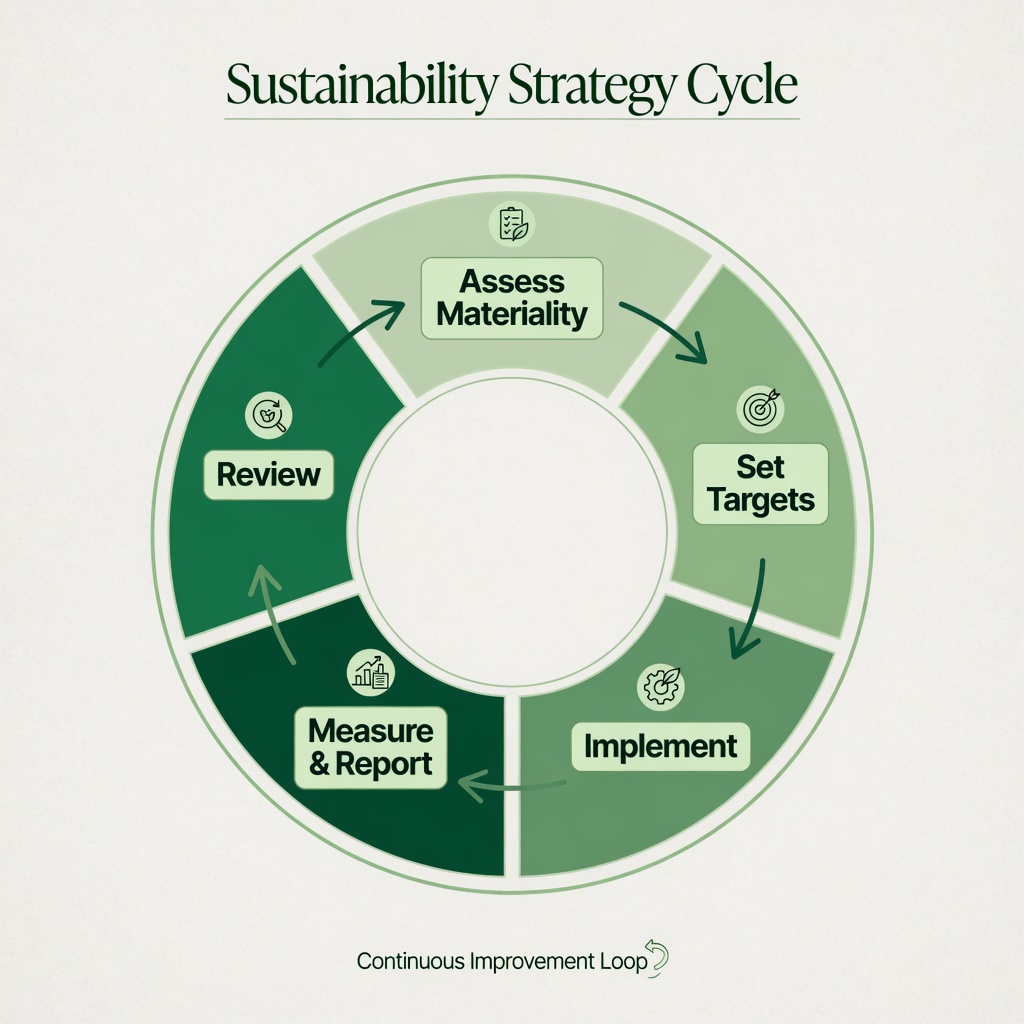
Improvement follows a cycle: assess materiality → baseline → set targets → deliver initiatives → measure → report → refresh. Avoid launching disconnected initiatives without governance or data.
What should sustainability goals include?
Goals should be specific, measurable, time-bound, owned, and based on baseline data. Include interim milestones and link to operational initiatives with budget and accountability.
How long does building sustainability strategy take?
A foundational strategy (materiality, governance, goals, Phase 1 roadmap) typically takes 3–6 months. Full data maturity and comprehensive reporting often take 18–36 months.
Is a sustainability strategy the same as an ESG strategy?
They overlap significantly. ESG strategy explicitly includes governance (G) alongside environmental and social topics. Many UK businesses use the terms interchangeably; align with stakeholder language in your sector.
Do UK SMEs need a written sustainability strategy?
Not legally in most cases, but customers, tenders, and lenders increasingly require one. A documented strategy improves consistency and reduces greenwashing risk when making public claims.
How does sustainability strategy relate to net zero?
If climate is material, your sustainability strategy should reference a net zero strategy or decarbonisation pathway. Net zero is a subset of broader sustainability strategy for many organisations.
What is a sustainability roadmap?
A phased delivery plan sequencing initiatives by priority, cost, and dependency—typically spanning 3–5 years with named owners, budgets, and KPI links.
How do we embed sustainability in procurement?
Set sustainable sourcing criteria in category strategies, include environmental and labour clauses in contracts, assess top suppliers on material topics, and link procurement KPIs to sustainable procurement.
Should we certify before or after strategy?
Strategy should define priorities first. Certification (e.g., ISO 14001) supports environmental management where stakeholders require it—it should not substitute for broader materiality-led strategy.
Board Paper: Sustainability Strategy Approval (Outline)
When seeking board sign-off, structure the paper as:
- Executive summary — material topics, headline goals, investment ask
- Drivers — regulation, customers, risk, opportunity, talent
- Materiality summary — methodology, stakeholders consulted, top topics
- Baselines — energy, emissions, waste, safety, social metrics
- Goals and KPIs — three-year targets with interim milestones
- Governance — oversight model, executive sponsor, working group
- Roadmap and budget — phased initiatives with owners
- Reporting plan — SECR, customer, voluntary frameworks
- Risks — delivery, data, greenwashing controls
- Board resolution — approve policy, goals, roadmap, resources
Board approval creates accountability for subsequent public claims in sustainability reporting.
Data and Systems for Strategy Delivery
Sustainability strategy fails without reliable data ownership:
| Data domain | Typical system | Owner |
|---|---|---|
| Energy and utilities | Finance, facilities, aM&T | Facilities / Finance |
| Travel | TMC, expenses | HR / Finance |
| Waste | Facilities, waste contractor portals | Operations |
| HR and safety | HRIS | HR |
| Procurement spend | ERP / procurement | Procurement |
Phase 1 strategy should assign data owners and define monthly collection routines—before investing in ESG software platforms.
Conclusion
Credible business sustainability strategies combine materiality, governance, measurable goals, a practical sustainability roadmap, and honest reporting. UK organisations that succeed treat building sustainability strategy as a management discipline—embedding sustainability in operations, procurement, and people decisions—not a one-off communications project.
Next steps:
- Materiality assessment — identify what matters
- Sustainable operations — operational delivery
- Environmental management system — structured environmental management
- Sustainability KPIs — measurement framework
- ESG strategy — broader E, S, and G approach
Sources
- UK Government — Environmental reporting guidelines including SECR
- UK Government — Green Claims Code
- UK Government — UK Sustainability Reporting Standards
- IEMA — Sustainability skills and competency guidance
- ISO — ISO 14001 Environmental management systems
This article is for general information only and does not constitute legal or compliance advice.