
What Is Greenwashing? Definition, Examples and How to Spot It
What Is Greenwashing? Definition, Examples and How to Spot It
Last updated: 24 June 2026 | Author: VerdaScope Editorial Team
If your UK business makes environmental claims—on packaging, websites, investor reports, or sales materials—you need to understand what is greenwashing and how regulators interpret misleading sustainability messaging. Greenwashing (sometimes written as green washing) is when a company creates a false or exaggerated impression that its products, services, or operations are better for the environment than the evidence supports. It is not always deliberate fraud; often it results from vague language, incomplete data, or marketing that highlights one positive feature while omitting material negatives.
This page is the hub for the Greenwashing pillar. It explains the greenwashing meaning in a UK business context, links to regulation and prevention guides, and shows how to spot greenwashing before it becomes a compliance or reputational problem.
Direct Answer
Greenwashing is the practice of making environmental claims—explicit or implied—that mislead consumers, investors, or business customers about the true environmental impact of a product, service, process, brand, or organisation. Claims may be literally true in part but still misleading if they omit important information, use vague terms without evidence, or suggest a product is greener than comparable alternatives without fair comparison. In the UK, misleading environmental claims can breach the Consumer Protection from Unfair Trading Regulations 2008 (CPRs) and related advertising rules. The Competition and Markets Authority (CMA) sets out six principles for compliant claims in its Green Claims Code (published September 2021).
Key Takeaways
- Greenwashing definition: presenting environmental credentials as better, broader, or more evidenced than they really are—through words, imagery, labels, or silence about material impacts.
- UK enforcement is active: the CMA has investigated sectors including fashion and secured formal undertakings from major retailers; the Advertising Standards Authority (ASA) also rules on misleading green ads.
- The CMA Green Claims Code requires claims to be truthful, clear, complete, fairly compared, life-cycle aware, and substantiated.
- Common greenwashing examples include vague terms (“eco-friendly”), unqualified recyclability claims, cherry-picked benefits, and offset-only “net zero” messaging without reduction detail.
- How to spot greenwashing: look for specificity, evidence, scope (whole product vs one attribute), and whether important caveats are visible—not buried in small print.
- Prevention is operational: governance, claim approval workflows, and documented substantiation—not a last-minute legal review of campaign copy.
- For practical steps, see how to avoid greenwashing. For legal detail, see UK Green Claims Code.
Topic Map: The Greenwashing Pillar
| Area | What you’ll learn | Go deeper |
|---|---|---|
| Core definition | What greenwashing means for UK businesses | This page |
| Types and examples | The seven common patterns and real brand cases | Types of greenwashing |
| Fashion sector | Fast fashion claims and CMA enforcement | Greenwashing in fashion |
| UK regulation | CMA, CPRs, ASA/CAP rules | UK Green Claims Code |
| EU rules for exporters | Substantiation and verification expectations | EU Green Claims Directive |
| Prevention | Governance, evidence, and review workflows | How to avoid greenwashing |
| Marketing compliance | Making legitimate green marketing claims | Making legitimate green marketing claims |
| Finance and ESG | Fund labels, SDR, and investment claims | Greenwashing in ESG investing |
Greenwashing Meaning: A Working Definition for UK Businesses
The term greenwash entered common usage in the 1980s, popularised by environmentalist Jay Westerveld, who criticised hotels that encouraged towel reuse while expanding environmentally damaging operations. Today, greenwashing meaning in business covers a wide spectrum—from careless overstatement to deliberate deception.
For UK organisations, a practical greenwashing definition has three elements:
- A claim about environmental performance — explicit (“100% recycled packaging”) or implied (green leaves, nature imagery, unqualified “sustainable collection” branding).
- A gap between claim and reality — the claim is false, exaggerated, unrepresentative, or missing material context.
- An effect on decisions — consumers, B2B buyers, or investors are likely to choose differently because of the impression created.
The CMA distinguishes genuine environmental claims (properly describing impact without hiding crucial information) from misleading claims (including accurate statements that still deceive through presentation or omission). That distinction matters because a claim can be factually correct yet unlawful if the overall impression is wrong.
What does greenwashing mean in everyday business language?
Teams often use “greenwashing” loosely to mean any sustainability marketing they distrust. Legally and regulatorily, the focus is narrower: misleading commercial practices relating to environmental credentials. A company that makes cautious, evidenced claims about a specific improvement is not greenwashing—even if the improvement is modest. A company that markets itself as “sustainable” while providing no substantiation and ignoring major impacts may be.
Greenwashing vs legitimate environmental marketing
| Legitimate claim | Potential greenwashing |
|---|---|
| “Packaging made from 80% post-consumer recycled plastic (certified to [scheme])” | “Eco packaging” with no material specification |
| “Scope 1 and 2 emissions reduced 12% vs 2022 baseline; methodology in annual report” | “Carbon neutral company” with no explanation of offsets or scope |
| “This garment contains 35% organic cotton; see fibre breakdown” | “Organic jeans” when only 35% of fibres are organic |
| “Working towards 50% recycled content by 2028; roadmap published” | “Committed to sustainability” with no measurable target or plan |
What Is Greenwashing in Business?
What is greenwashing in business depends on where claims appear and who reads them. The same underlying issue—overstated environmental benefit—can surface in:
- Consumer marketing (product pages, packaging, TV and digital ads)
- B2B sales materials (tenders, datasheets, distributor listings)
- Corporate communications (annual reports, CEO statements, website “purpose” pages)
- Finance and investment (fund names, ESG product descriptions, impact metrics)
- Employer brand (“green employer” recruitment campaigns)
UK consumer protection law applies most comprehensively to business-to-consumer (B2C) claims, but B2B advertising is also regulated against misleading marketing. The CMA explicitly urges businesses to apply the same high standards in B2B relationships, particularly where small business buyers rely on manufacturer information.
Why greenwashing matters commercially
Beyond regulatory risk, greenwashing erodes trust. CMA sector work has highlighted consumer frustration when broad eco-language does not match product reality. In fashion, for example, the CMA noted concerns that collections marketed as sustainable could include products with as little as 20% recycled fabric, with vague criteria and prominent green imagery.
Reputational damage can outlast a single ad campaign. NGOs, journalists, and competitors scrutinise environmental claims more closely than a decade ago. For businesses investing genuinely in lower-impact products, greenwashing by others also creates unfair competition—precisely what consumer protection law aims to prevent.
Business risks at a glance
| Risk type | What can happen |
|---|---|
| Regulatory | CMA investigation, court action, undertakings, ASA rulings and ad withdrawal |
| Civil | Consumer redress claims where breaches harm purchasers |
| Commercial | Lost contracts, retailer delisting, failed tenders |
| Internal | Rework of packaging, websites, and training; senior management time |
| Financial | Fines (in some sectors), legal costs, campaign write-offs |
Note: specific penalties depend on the breach, sector, and enforcer. This is general context, not legal advice.
UK Regulatory Context: CMA Green Claims Code
UK greenwashing regulation is not a single “greenwashing act.” It sits within existing consumer protection and advertising law, guided by the CMA Green Claims Code (September 2021).
The code’s six principles require that environmental claims:
- Are truthful and accurate
- Are clear and unambiguous
- Do not omit or hide important relevant information
- Compare fairly and meaningfully (where comparisons are made)
- Consider the full life cycle of the product or service
- Are substantiated with robust, credible evidence
These principles align with the Consumer Protection from Unfair Trading Regulations 2008 (CPRs) and overlap with ASA/CAP Code rules on environmental claims in advertising. The CMA and ASA can both play a role; the CMA has stated it may refer advertising issues to the ASA.
For a full legal guide—including CPRs, BPRs, ASA processes, and compliance checklists—see UK Green Claims Code.
CMA enforcement snapshot
The CMA’s work on misleading environmental claims includes sector reviews and targeted investigations. A high-profile example is the fashion investigation into ASOS, Boohoo, and George at Asda:
- July 2022: CMA opened investigations into eco-marketing of fashion collections (including ASOS’s “Responsible edit,” Boohoo’s “Ready for the Future,” and George’s “George for Good”), citing concerns about vague language, low thresholds for “green” ranges, and misleading imagery.
- March 2024: The CMA announced undertakings from all three retailers, requiring clearer fabric statements, transparent collection criteria, accurate filters, substantiated targets, and reporting to the CMA. The CMA also issued an open letter to the wider fashion sector.
The CMA stated these undertakings were provided voluntarily and without admission of wrongdoing—but they set a visible benchmark for how green claims should be presented.
Greenwashing Examples: Patterns You Will Recognise
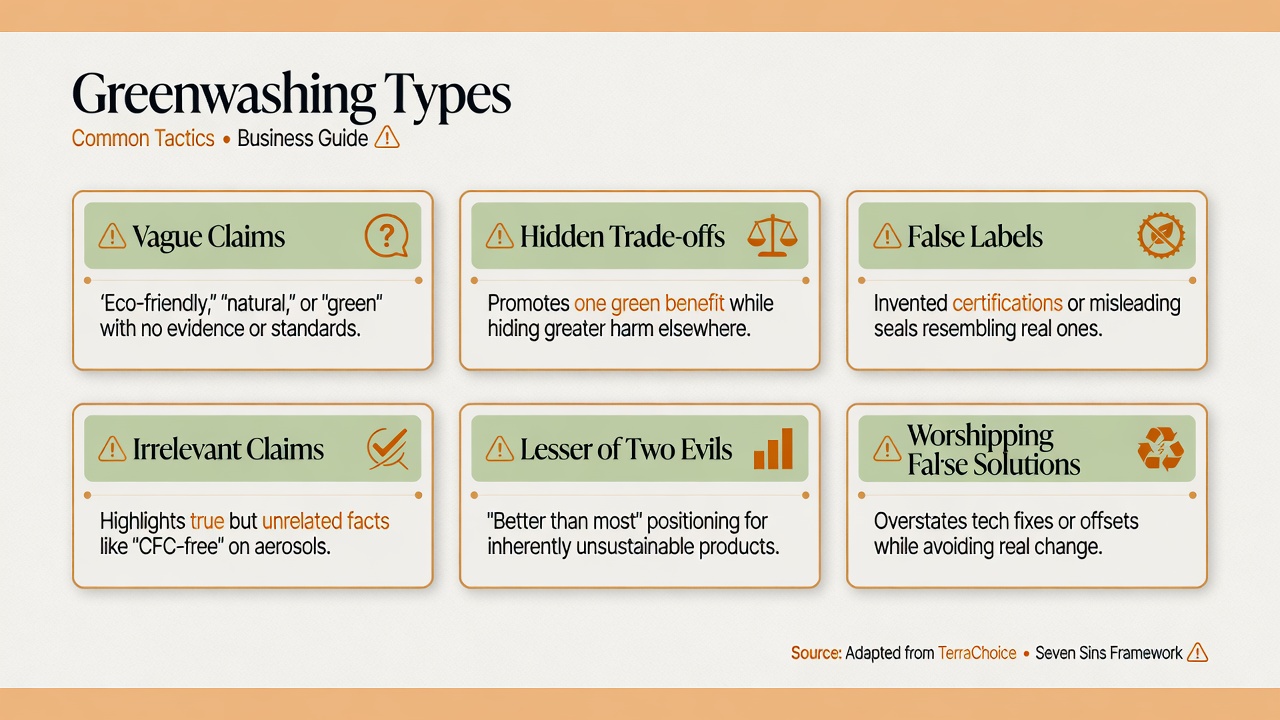
Greenwashing examples typically fall into recurring patterns. The TerraChoice framework—often called the seven sins of greenwashing—remains a useful teaching tool. Our dedicated guide maps each sin to UK-relevant cases: types of greenwashing.
1. Hidden trade-off
Highlighting one green attribute while ignoring significant environmental costs elsewhere.
Example pattern: marketing paper packaging while omitting high-carbon logistics or non-recyclable laminates.
2. No proof
Making claims without accessible substantiation.
Example pattern: “environmentally friendly formula” with no test method, benchmark, or third-party reference.
3. Vagueness
Using broad terms whose meaning consumers cannot verify.
Example pattern: “green,” “eco,” “natural,” or “sustainable” without qualification. The CMA warns these terms suggest positive or neutral overall impact unless evidence proves it.
4. False labels or misleading credentials
Using logos, icons, or certification marks that imply independent verification when none exists—or misrepresenting the scope of accreditation.
5. Irrelevance
Claiming an environmental benefit that is legally required or industry-standard, implying exceptional performance.
CMA example: stating rinse-off cosmetics are “microbead free” when microbeads are already banned in such products in the UK.
6. Lesser of two evils
Framing a harmful product category as “greener” without addressing the category’s fundamental impact.
Example pattern: “greener cigarettes” or marketing fast fashion as sustainable without addressing volume and disposal.
7. Fibbing
Claims that are simply false or fabricated.
Example pattern: stating recycled content percentages that laboratory testing cannot verify.
UK brand cases worth studying
| Case / sector | What regulators or authorities queried | Lesson |
|---|---|---|
| ASOS, Boohoo, George at Asda (CMA, 2022–2024) | Vague “responsible” ranges, low recycled-fabric thresholds, misleading filters and imagery | Collection-level claims need published criteria and product-level specificity |
| Fashion sector broadly (CMA sector review) | Broad “sustainable” impressions with little supporting detail | Imagery and range names carry as much weight as text claims |
| H&M Conscious Collection (Norwegian Consumer Authority, 2021) | Insufficient detail backing environmental labels on garments | Labelling must be substantiated and understandable—not generic “conscious” tags |
| Energy and household goods (ASA rulings, various) | “Green” energy tariffs, recyclability, and carbon claims lacking clarity | ASA applies CPR principles via advertising codes |
Cases develop over time. Always check the latest CMA, ASA, and court outcomes before citing enforcement status.
How to Spot Greenwashing: A Practical Checklist
How to spot greenwashing does not require a law degree. It requires disciplined questions—ideally embedded in marketing and product approval workflows.
Seven questions before you publish
- Is the claim specific? Can a reader tell exactly what environmental attribute is being claimed?
- Is evidence available? Could you produce substantiation within 24–48 hours if the CMA or ASA asked?
- Is scope clear? Does the claim apply to the whole product, packaging only, one facility, or one SKU?
- Are caveats prominent? Are conditions (e.g. industrial composting only) visible at point of decision—not only in a footnote?
- Is the life cycle considered? Have you accounted for sourcing, manufacture, use, and end-of-life—not only one stage?
- Is the comparison fair? Same methodology, same time period, like-for-like products?
- Would a reasonable customer feel misled? If they learned the full picture post-purchase, would they complain?
Red flags in customer-facing materials
- Green leaf icons or “nature” visuals on otherwise conventional products
- “Sustainable collection” with no published entry criteria
- “Recyclable” without saying what parts, where, and by whom
- “Carbon neutral” without separating reduction vs offset
- “Organic” or “recycled” on products that only partially qualify
- Future targets presented as current achievements
For a step-by-step organisational approach, see how to avoid greenwashing and making legitimate green marketing claims.
Greenwashing and Carbon Offsetting
A frequent cross-pillar question is whether offsetting equals greenwashing. The answer is: it depends on how it is communicated.
Offsetting can support climate action when disclosed honestly, using credible projects, and alongside measurable emissions reduction. It becomes misleading when:
- offsets are presented as eliminating emissions from a product without clarifying residual impact;
- reduction and removal are conflated;
- offset quality, permanence, and additionality are not explained; or
- “net zero” branding suggests no ongoing emissions when operations still produce substantial greenhouse gases.
The CMA’s Green Claims Code specifically cautions that consumers may be misled if offset-heavy claims imply products or processes generate few emissions in reality. For a balanced treatment of offsets, see carbon offsetting and greenwashing.
Greenwashing by Sector: Finance, Fashion, and Beyond
Environmental claims fail in sector-specific ways. Two high-traffic areas:
Fashion
Fast fashion’s scale—high volume, short life, synthetic fibres, and global supply chains—makes broad sustainability claims especially sensitive. The CMA’s fashion undertakings address filters, fabric percentages, range criteria, and imagery. Read the sector guide: greenwashing in fashion.
Finance and ESG investing
ESG greenwashing includes fund names or marketing that imply stronger sustainability characteristics than portfolio holdings or policies support. The FCA’s Sustainability Disclosure Requirements (SDR) regime, including an anti-greenwashing rule for authorised firms, aims to address this in UK retail investment markets. See greenwashing in ESG investing and the wider ESG investing guide.
Implementing Credible Claims: A Path for UK Organisations
Avoiding greenwashing is a management system, not a copywriting exercise.
Step 1: Inventory existing claims
Audit websites, packaging, ads, tenders, investor slides, and sales sheets. List every environmental claim, implied claim (imagery counts), and third-party logo.
Step 2: Map legal and code requirements
Align with the six CMA principles and ASA/CAP guidance. If you sell into the EU, monitor EU Green Claims Directive developments—UK exporters may face substantiation and verification requirements beyond UK law.
Step 3: Assign ownership
Marketing cannot own substantiation alone. Typical roles:
| Role | Responsibility |
|---|---|
| Sustainability / operations | Data, life-cycle information, target tracking |
| Legal / compliance | CPRs, sector rules, claim approval |
| Marketing | Clear customer language, prominent caveats |
| Procurement | Supplier evidence for Scope 3 and materials claims |
| Leadership | Tone from the top; avoid pressuring teams to overclaim |
Step 4: Build substantiation files
For each claim, document: claim text, evidence source, date, scope, assumptions, approvals, and review date. If evidence is weak, narrow or withdraw the claim.
Step 5: Train customer-facing teams
Sales and account managers often improvise “green” language. Provide approved claim banks and escalation routes.
Step 6: Monitor and update
Environmental performance, recycling infrastructure, and regulation change. Schedule claim reviews after material operational changes—not only annually.
Step 7: Consider external assurance
For high-stakes claims (net zero pathways, comparative LCAs), third-party assurance may reduce risk. Self-declared badges without criteria remain a common enforcement trigger.
Step 8: Review third-party and marketplace claims
Distributors, retailers, and comparison sites often paraphrase your environmental claims. Provide approved copy in partner portals. Monitor Amazon A+ content, Google Shopping titles, and affiliate sites for drift. Marketplace “eco” badges you did not authorise can still create consumer impressions for which you may share liability as manufacturer or brand owner.
Common Mistakes UK Businesses Make
- Treating “legal” as “accurate enough” — complying with minimum labelling rules does not automatically justify broader “green” marketing.
- Letting designers lead claim language — visuals can mislead even when body copy is cautious.
- Publishing targets as achievements — future goals need clear timelines and strategies, per CMA guidance.
- Copying competitor claims — their substantiation is not yours.
- Ignoring B2B listings — distributor portals and retailer templates multiply non-compliant claims.
- Assuming small businesses are invisible — Trading Standards and the ASA also act on SME advertising.
- Forgetting post-Brexit EU sales — EU consumer law may apply to UK exporters’ EU-facing claims.
Greenwashing vs Greenhushing
As enforcement tightens, some businesses swing from overclaiming to greenhushing—staying silent about genuine environmental progress for fear of criticism. That is not the regulatory objective. The CMA encourages accurate claims that help consumers choose better products. The practical middle path is narrow, evidenced communication: report measurable improvements with clear scope, not broad virtue signalling.
| Greenwashing | Greenhushing | Balanced approach |
|---|---|---|
| “100% sustainable brand” | Hiding verified recycled content on spec sheets | “This SKU: 85% recycled aluminium; see take-back scheme” |
| Implied net zero from offsets only | No customer communication despite emissions cuts | “Scope 1+2 down 14% since 2023; method in sustainability report” |
Sector Snapshot: Where Claims Fail Most Often
| Sector | Typical claim | Why it attracts scrutiny |
|---|---|---|
| Fashion | “Responsible” / “conscious” ranges | Volume, synthetics, and vague collection criteria |
| Energy and utilities | “Green” tariffs | Renewable backing and consumer understanding |
| Food and drink | “Compostable” packaging | Industrial vs home composting confusion |
| Finance | “Sustainable fund” labels | Holdings mismatch and naming rules (FCA SDR) |
| Automotive | “Zero emissions” | Tailpipe vs life-cycle interpretation |
| FMCG | “Plastic-free” | Components and caps omitted |
Sector guides elsewhere on this site deepen operational context; this pillar focuses on claim integrity across sectors.
How This Pillar Connects to the Wider Site
Greenwashing sits at the intersection of sustainability strategy and trust. Readers often arrive from:
- What is sustainability in business — foundational definitions
- Carbon offsetting — offset-related claim risks
- ESG reporting — investor-facing disclosure consistency
- Sustainability audit — claim and data review
Credible sustainability work deserves credible communication. This pillar helps you tell the truth precisely—not stay silent.
Frequently Asked Questions
What is greenwashing?
Greenwashing is when environmental claims—words, imagery, labels, or omissions—mislead people about the true environmental impact of a product, service, or business. In the UK, misleading claims may breach consumer protection and advertising rules.
What does greenwashing mean?
In plain terms, greenwashing means “green marketing that does not match green reality.” It can involve false statements, vague terms, hidden trade-offs, or accurate facts presented in a deceptive way.
What is greenwashing in business?
In business, greenwashing covers misleading environmental claims in consumer ads, B2B marketing, packaging, corporate reports, and investment products. UK regulators expect claims to be substantiated and material information not omitted.
What is the greenwashing definition used by UK regulators?
The CMA does not use a separate statutory definition of “greenwashing.” It assesses whether environmental claims are misleading under the CPRs, guided by six Green Claims Code principles: truthful, clear, complete, fairly compared, life-cycle aware, and substantiated.
What are common greenwashing examples?
Common examples include unqualified “eco-friendly” labels, “recyclable” claims that apply only to packaging, “carbon neutral” statements without explaining offsets, “sustainable ranges” with unpublished criteria, and green imagery on conventional products.
How to spot greenwashing?
Ask whether the claim is specific, evidenced, scope-clear, fairly compared, life-cycle aware, and prominently caveated. If broad terms or icons imply overall environmental benefit without proof, treat it as high risk.
Is greenwashing illegal in the UK?
Misleading environmental claims can be unlawful under the CPRs and related advertising rules. Outcomes range from undertakings and ad bans to court enforcement. Whether a specific claim breaches the law depends on circumstances and evidence.
What is the CMA Green Claims Code?
The Green Claims Code is CMA guidance (September 2021) on making environmental claims under existing UK consumer protection law. It sets six principles businesses should follow. See UK Green Claims Code.
Is carbon offsetting greenwashing?
Not necessarily. Offsetting becomes misleading when marketed as eliminating emissions without explaining residual impact, offset quality, or reduction efforts. Honest, specific disclosure is essential. See carbon offsetting.
How can businesses avoid greenwashing?
Use claim approval workflows, document substantiation, avoid vague terms, disclose material caveats, and review imagery and filters—not only text. See how to avoid greenwashing.
What is the difference between greenwashing and green marketing?
Green marketing promotes genuine environmental attributes with evidence. Greenwashing misleads through exaggeration, vagueness, or omission. A product may legitimately market recycled content; it greenwashes when it implies the entire business model is sustainable without proof.
Who enforces greenwashing rules in the UK?
The CMA, Trading Standards, and ASA (for advertising) are primary enforcers. The FCA regulates sustainability references on investment products. Firms selling to UK consumers from overseas remain subject to UK consumer protection law.
Historical Context: From “Greenwash” to Regulated Claims
Understanding what is greenwashing benefits from brief history. Early corporate environmental advertising in the 1980s and 1990s often featured unsubstantiated nature imagery—a practice critics labelled greenwash. Academic and NGO scrutiny grew through the 2000s as carbon footprinting, life-cycle assessment, and ecolabels matured.
The UK’s current approach does not ban environmental marketing. It requires that marketing meet standards consumers reasonably expect: honesty, clarity, and evidence. That shift—from rhetorical sustainability to demonstrable sustainability—mirrors parallel developments in ESG reporting and climate disclosure. Businesses that invested early in data collection are better placed to market without crossing into greenwashing; those that led with slogans now face retrospective audits of websites and packaging archives.
Sources and Further Reading
- Competition and Markets Authority, Making environmental claims on goods and services (Green Claims Code), September 2021 — gov.uk
- Competition and Markets Authority, press release on ASOS, Boohoo, and Asda investigation, 29 July 2022 — gov.uk
- Competition and Markets Authority, press release on undertakings from ASOS, Boohoo, and Asda, 27 March 2024 — gov.uk
- Consumer Protection from Unfair Trading Regulations 2008 (CPRs)
- Business Protection from Misleading Marketing Regulations 2008 (BPRs)
- Committee of Advertising Practice (CAP), rules on environmental claims
- European Commission, Green Claims initiative overview — environment.ec.europa.eu
Regulatory enforcement and EU legislative status change over time. Verify current requirements with official sources or qualified advisers before relying on compliance statements.
Next Steps
Choose your next read based on your role:
- Understand patterns and case studies → Types of greenwashing
- Meet UK legal requirements → UK Green Claims Code
- Build internal controls → How to avoid greenwashing
- Export to the EU → EU Green Claims Directive
- Marketing and ad compliance → Making legitimate green marketing claims
- Finance and funds → Greenwashing in ESG investing
If you need help reviewing claims, data, and governance together, a structured sustainability audit can identify gaps before regulators or customers do.
Remember: the goal is not silence—it is accuracy. Specific, evidenced claims build the trust that vague “green” slogans destroy.