
The 3 Pillars of Sustainability Explained: People, Planet, Profit
The 3 Pillars of Sustainability Explained: People, Planet, Profit
Last updated: 24 June 2026 | Author: VerdaScope Editorial Team
The pillars of sustainability give businesses a simple structure for decisions that are often described in complex ESG language. Most commercial frameworks boil down to three interconnected dimensions: People (social), Planet (environmental), and Profit (economic)—together known as the triple bottom line or TBL framework. Understanding what are the pillars of sustainability helps UK and international firms balance trade-offs, set metrics, and communicate strategy without reducing everything to carbon alone.
This guide explains each pillar, shows how they interact, and offers practical environmental social economic sustainability applications for organisations of different sizes.
Direct Answer
The three pillars of sustainability are People (social equity, health, and community wellbeing), Planet (environmental protection and responsible resource use), and Profit (economic viability and governance). In business, the triple bottom line means measuring and managing performance across all three—not maximising financial returns while ignoring social and environmental consequences.
Key Takeaways
- The pillars of sustainability translate abstract “sustainability” into three management domains leaders already recognise.
- John Elkington coined the triple bottom line in 1994; it remains a widely used sustainability framework for corporates and SMEs.
- Weak performance in one pillar can undermine the others—e.g. environmental incidents damage profit through fines and reputation loss.
- Environmental sustainability is one pillar, not the whole model; social and economic dimensions are equally structural.
- Use pillar thinking for materiality, KPIs, and reporting—but avoid treating pillars as silos.
- For full business context, see what is sustainability in business and what is sustainable business.
The Three Pillars Diagram
The pillars are interdependent. Visually, they are often shown as three overlapping circles or a triangle with “sustainability” at the centre—indicating that lasting outcomes sit where dimensions align.
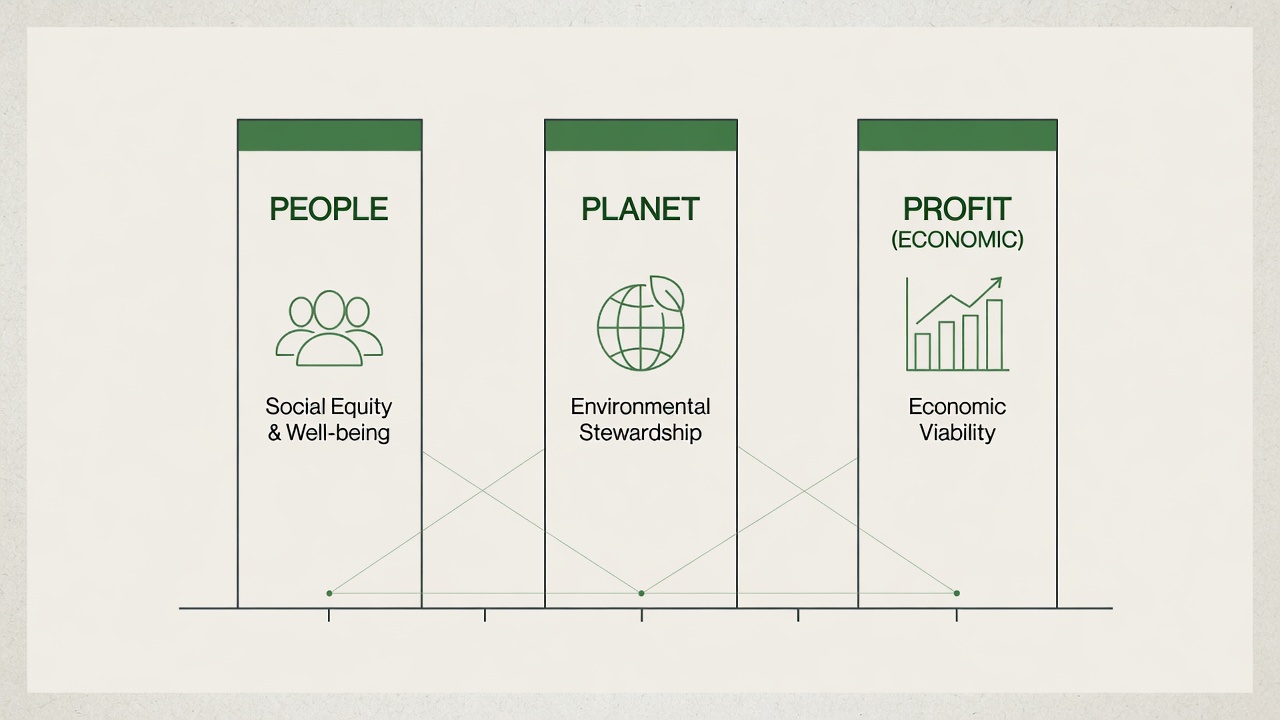
No organisation achieves perfect balance in every metric simultaneously. The goal is informed trade-offs, transparent priorities, and improvement over time—not cosmetic balance sheets.
Pillar One: Planet (Environmental Sustainability)
Environmental sustainability concerns how business activity affects ecosystems, climate, water, air, materials, and biodiversity—and how dependent the business is on those systems continuing to function.
What it covers in business
| Topic | Example business questions |
|---|---|
| Climate | What are our greenhouse gas emissions (Scopes 1, 2, 3)? Do we have reduction targets? |
| Energy | How much electricity and fuel do we use? Can we improve efficiency or use renewables? |
| Waste and materials | How much waste goes to landfill? Can we design for reuse or recycling? |
| Water | Where is water stress relevant to operations or supply chains? |
| Pollution | Are emissions to air, water, or soil controlled and permitted? |
| Biodiversity | Does land use or sourcing affect habitats (relevant in construction, agriculture, extractives)? |
UK context
The UK Climate Change Act 2008 sets a statutory framework for reducing national emissions, with a net zero target for 2050. Many businesses align corporate climate commitments with this direction. Operational reporting for qualifying large entities may include energy and carbon under Streamlined Energy and Carbon Reporting (SECR). Implementation detail: achieving net zero.
Common mistakes
- Treating recycling alone as sufficient environmental strategy
- Publicising carbon neutrality for a narrow scope while ignoring broader emissions
- Ignoring supply chain (Scope 3) impacts when they dominate the footprint
Pillar Two: People (Social Sustainability)
The People pillar addresses how the organisation affects individuals and communities—inside and outside the company.
What it covers in business
| Topic | Example business questions |
|---|---|
| Workforce | Are pay, hours, and conditions fair and safe? Is there inclusion and development opportunity? |
| Health and safety | Are incidents tracked and prevented? |
| Human rights | Are there risks of forced labour or child labour in supply chains? |
| Customers | Are products safe, accessible, and honestly marketed? |
| Communities | Does the business create local jobs, noise, or pollution burdens? |
| Diversity and inclusion | Are recruitment and promotion equitable? |
UK context
UK employment law sets minimum standards on wages, discrimination, and health and safety. The Modern Slavery Act 2015 requires certain organisations to publish annual statements on slavery and trafficking in supply chains. Public sector procurement often scores social value—including local employment and fair work practices.
Common mistakes
- Charitable donations presented as substitute for unsafe working conditions
- Diversity statistics without inclusion or retention outcomes
- Supplier codes of conduct with no audit or engagement programme
Pillar Three: Profit (Economic Sustainability)
Profit in the TBL framework does not mean short-term earnings at any cost. It refers to economic sustainability: the business model, governance, and financial health that allow environmental and social commitments to endure.
What it covers in business
| Topic | Example business questions |
|---|---|
| Financial resilience | Can the business withstand shocks—energy price spikes, supply disruption, regulatory change? |
| Governance | Is there board oversight, ethical conduct, and transparent reporting? |
| Innovation and efficiency | Do processes reduce cost and resource intensity together? |
| Tax and economic contribution | Is the organisation’s economic role responsibly managed (without aggressive avoidance conflicting with stated values)? |
| Long-term value | Are investments evaluated on lifecycle impacts, not purchase price alone? |
UK context
UK corporate governance codes and reporting requirements (varying by listing status and size) increasingly expect boards to consider climate and broader sustainability risks. Lenders may request ESG information as part of credit assessment. See ESG reporting requirements for reporting structures that often map to all three pillars.
Common mistakes
- Cutting maintenance or safety spend to boost quarterly profit
- Sustainability projects with no business case or owner—abandoned in downturns
- Treating governance as compliance checkbox only
How the Pillars Interact: Why Balance Matters
The pillars of sustainability are not independent columns. Trade-offs and synergies connect them.
Synergy examples:
- Energy efficiency (Planet) lowers bills (Profit) and may improve indoor conditions (People).
- Fair wages and training (People) can reduce turnover (Profit) and improve service quality.
- Durable product design (Planet) can increase customer satisfaction (People) and repeat revenue (Profit).
Tension examples:
- Rapid automation (Profit) may displace jobs (People) without a transition plan.
- Strict environmental standards (Planet) may raise short-term costs (Profit) unless designed efficiently.
- Aggressive sales targets (Profit) may encourage misleading green claims (Planet/People via trust harm).
Sustainable leadership makes trade-offs explicit, documents decisions, and revisits assumptions as evidence accumulates.
Triple Bottom Line vs Other Frameworks
| Framework | How it relates to the three pillars |
|---|---|
| Brundtland definition | Philosophical foundation—intergenerational equity |
| Triple bottom line (TBL) | Operational shorthand—People, Planet, Profit |
| ESG | Investor/reporting categories mapping largely to the same domains |
| UN SDGs | 17 detailed goals nesting under social, environmental, and economic themes |
| ISO 26000 | Guidance on social responsibility spanning all pillars |
Elkington later argued (2018) that the TBL concept had sometimes been diluted to accounting exercises. Used well, it remains a pedagogical and strategic sustainability framework—not merely a reporting template.
Applying the Pillars in UK Business Practice
For SMEs
- Planet: Utility bills, waste contracts, fleet fuel—baseline in spreadsheets.
- People: HR policies, safety records, supplier questions on labour standards.
- Profit: Cash flow impact of efficiency projects; simple governance (who signs off claims).
For mid-market and large firms
- Integrated KPI dashboards with pillar owners
- Materiality assessment feeding sustainable business strategy
- Pillar-aligned sections in annual reports or ESG disclosures
Example: UK office-based services firm
| Pillar | Actions |
|---|---|
| Planet | Renewable electricity tariff, print reduction, remote meeting default |
| People | Wellbeing programme, apprenticeship intake, modern slavery supplier statement |
| Profit | Board review of climate risk in annual planning, ethics training for client-facing staff |
Example: UK light manufacturer
| Pillar | Actions |
|---|---|
| Planet | LED retrofit, waste metal recycling, Scope 1 and 2 measurement |
| People | Living Wage commitment, safety committee, noise controls for neighbours |
| Profit | Equipment upgrade appraised on ten-year energy cost, not purchase price alone |
Measuring Performance Across Pillars
Measurement makes the TBL framework actionable. Typical indicators:
| Pillar | Example metrics |
|---|---|
| Planet | tCO₂e emissions, MWh energy, tonnes waste diverted, water use |
| People | Lost-time injury rate, turnover, gender pay gap (where published), training hours, supplier audit coverage |
| Profit | Revenue, margin, investment in maintenance and R&D, ethics breaches, tax approach disclosures |
Not every metric suits every business. Select indicators material to your operations and stakeholder questions. Improve data quality iteratively—estimated emissions with documented methodology beat unmeasured assertions.
Pillars, Greenwashing, and Credibility
Organisations sometimes emphasise one pillar in marketing while neglecting others—classic “greenwashing” when Planet claims lack substance. Social “people washing” and financial greenwashing in ESG funds show similar patterns.
Credible use of the pillars of sustainability requires:
- Consistent narrative across all three dimensions
- Evidence for public claims (CMA Green Claims Code in the UK)
- Acknowledgement of weak areas with improvement plans
Read sustainability vs greenwashing before using pillar language in campaigns.
Frequently Asked Questions
What are the pillars of sustainability?
The three pillars are People (social), Planet (environmental), and Profit (economic). Together they describe balanced environmental social economic sustainability.
What is environmental sustainability?
Environmental sustainability is managing business activity so natural systems and resources can support current and future needs—covering climate, energy, waste, water, pollution, and ecosystems. It is one pillar of the broader sustainability model, not the whole definition.
What is the triple bottom line?
The triple bottom line is a framework suggesting businesses should measure social and environmental performance alongside financial results—People, Planet, Profit. John Elkington introduced the term in 1994.
What is the TBL framework?
The TBL framework is the same as the triple bottom line: a three-part lens for strategy, metrics, and reporting. It helps organisations avoid treating sustainability as only environmental compliance.
How do the pillars relate to ESG?
ESG (Environmental, Social, Governance) largely maps to Planet, People, and Profit/governance respectively. ESG is common in investor reporting; the three pillars are often easier for operational teams and SMEs to apply.
Can a business prioritise one pillar?
Businesses inevitably prioritise material issues, but long-term success usually requires minimum standards across all three. Overemphasising Profit while neglecting Planet or People often creates regulatory, legal, or reputational risk.
Are the SDGs connected to the three pillars?
Yes. The 17 UN Sustainable Development Goals span social, environmental, and economic themes. Businesses often map SDG alignment to pillar strategies—see UN SDGs for business.
Sources
- John Elkington, “Towards the Sustainable Corporation: Win-win-win business strategies for sustainable development,” California Management Review, 1994
- John Elkington, “25 Years Ago I Coined the Phrase ‘Triple Bottom Line.’ Here’s Why It’s Time to Rethink It,” Harvard Business Review, 2018
- United Nations, Brundtland Commission, Our Common Future, 1987
- UK Government, Climate Change Act 2008
Next Steps
- Hub overview → What is sustainability in business?
- Operating model → What is sustainable business?
- Why it matters → Why is sustainability important for business?
- Global goals → UN SDGs for business